I'll ask you questions. I'll never do the maths for you. The steps are always yours.
The shape of this page is Writer, by David — a self-guided writing coach. Coach asks of a step what Writer asks of a sentence.
Before anything else
This page is addressed to one person. If it reads like a father talking to his son, that is because that is exactly what it is. I am Dave's dad. I wrote it after a policy landed on his project before he got the chance to show it to anybody, and I did not want the only thing he heard about it to be that it was not allowed.
His classmates are welcome to read someone else's mail. Everything in here is as true for you as it is for him, and none of it asks anyone's permission — not mine, not a school's. But I am not going to dress it up as a general-audience document, because it isn't one, and a page that pretends about small things should not be trusted about large ones.
So: Dave. And anyone standing near him.
— Dad (Grossi) · Newark, September 2026
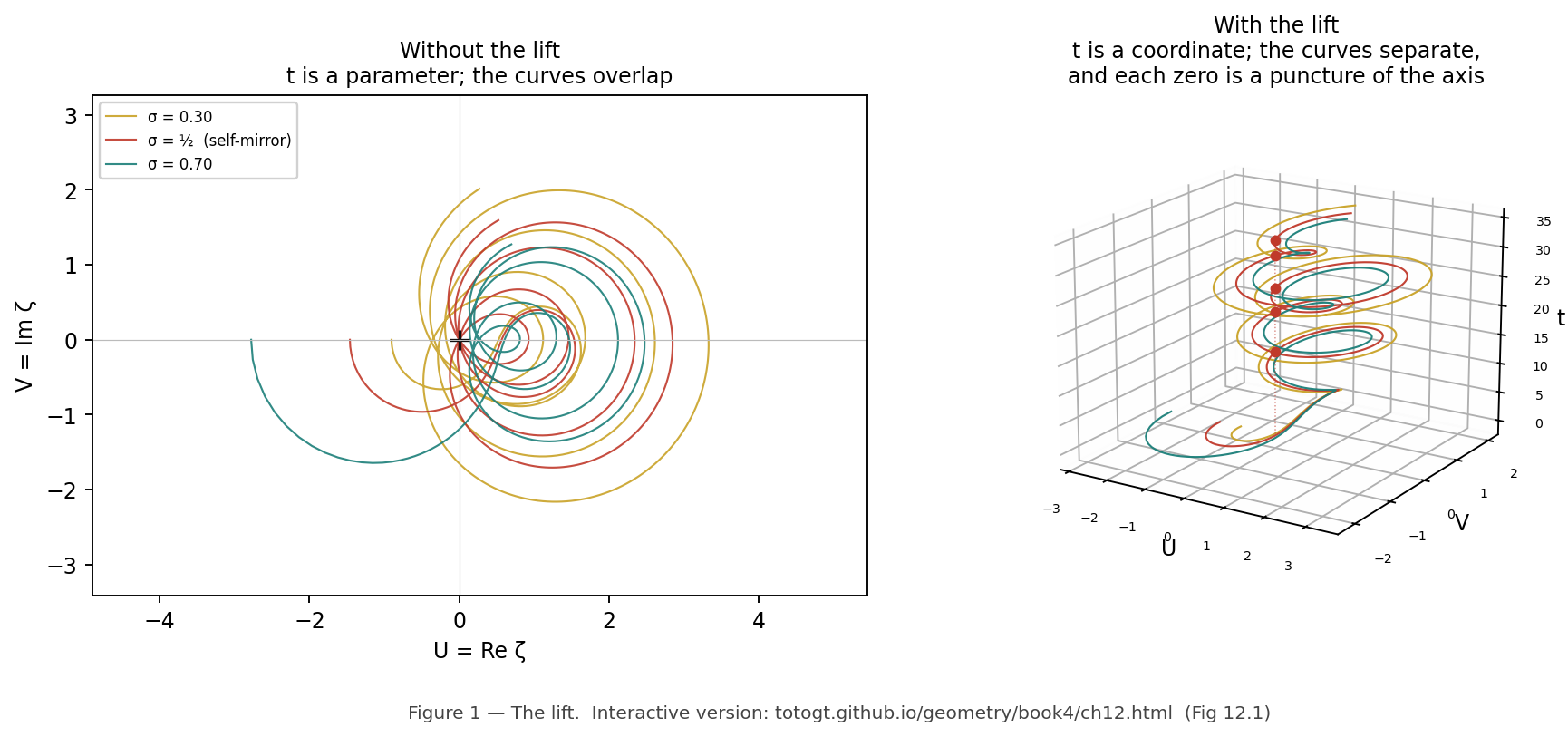
That picture is my signature, and it is a real figure out of a real paper — Figure 1 of the RH work, the Riemann zeta function lifted: taken out of the flat complex plane and put into three dimensions, so that t stops being a parameter and becomes a coordinate. On the left the curves lie on top of each other and you cannot tell them apart. On the right they come apart, and every zero turns into a puncture of the axis.
I use it as a signature because, as far as I know, I am the only person who has lifted RH this way. That is not a claim to have proved anything — the paper says plainly that RH itself is untouched, and it is a translation between two languages rather than a result. But the picture is mine.
And that is the other reason it is here, Dave. You have seen me at this for years without me ever putting a page of it in front of you. This is a page of it.
01What got banned, and what didn't
On 2 September 2026 New York City Public Schools restricted student-facing generative AI for grades 2-K through 8. The rule names chatbots and AI tutors. If your idea was a set of prompts you paste into a chatbot, the rule reached it before you got to show anyone.
So read the rule closely, because it is narrower than the panic around it. It does not say no computers. It does not say no mathematics done with machines. It names one category of tool: the kind that produces an answer you have no way to check.
The thing worth noticing
Writer's promise is "I'll ask you questions. I'll never write it for you. The words are always yours." A tool that refuses to produce the work is not the tool the rule is about. It is the opposite tool. The idea was never the problem.
What was the problem is the delivery. The questions were good; they just arrived through a chatbot, and the chatbot is what the rule names. That is a fixable engineering fact, not a verdict on the idea.
The fix: take the model out. The coaching was never in the model. It was in the questions — and someone wrote those. If the questions are a fixed, finite, authored list, then the thing asking them generates nothing, predicts nothing, and cannot be talked into agreeing with you. It is a deck of cards that happens to be a web page.
Everything below this line is that. There is no AI in this page. There is no network call in this page. There are fifty questions, written by a person, and a button that shows you the next one.
02If the rule felt like it was about you
It wasn't. It was written for a real and specific problem: work handed in that a machine wrote, by students who could not have checked it and did not try. That problem exists, and a school is right to care about it.
Your idea got caught because it travelled down the same pipe. Not because of what it did — because of what it ran on. Being caught by a rule you were never the target of is a different thing from being told you were wrong, and at eleven those two feel identical. They are not. Learn to tell them apart now and it will save you a great deal later, because it will keep happening.
But there is a cost here that is worth naming out loud, because the people who wrote the rule were not thinking about it.
The expensive part
In a lot of schools, a fair number of the people around you have already decided, quietly, that college is not for people like them. Nobody announces it. It just settles. And a rule that lands on a kid at the exact moment he is excited about learning does not only stop one project — it can help settle that question years before it should have been asked.
Excitement is the scarce thing here. Not talent, and not intelligence. Those are much more common than anybody admits. What is rare is a person who is currently, actively interested, and that state is fragile in a way nobody warns you about.
So the counter-move is deliberately unsentimental: get something nobody can revoke.
Encouragement is worth very little, and you should be suspicious of adults who offer only that. A transcript is worth a lot. Three college credits is not somebody's opinion about your potential — it is a record, held by an institution, that says you already did the thing. A policy can change next term. A teacher can move schools. A passed exam cannot be un-passed. That is why the credit section further down is not a bonus at the end of this page. It is the reason the page exists.
And notice what none of it requires. Lean is free, public, and runs in a browser. CLEP has no minimum age. Neither of them needs a school to say yes first, and neither of them will ask you where you live or what your cousins think.
Related, and more careful than this page can be
The longer argument — that a door being open is not the same as a door being reachable, and that access is a question of how many doors, how wide, and how far from where you live — is in What a Child Can Enter, Book 7 of Principia Orthogona. This page does not claim a credit fixes any of that. It claims a credit is one thing that becomes yours and stays yours, which is not nothing.
03Coach
Pick where you are. Answer on paper, out loud, or to somebody. Then press for the next question. Coach never tells you whether you are right — that is a different machine's job, and it is in the next section.
Coach
Choose a stage above and I'll start asking.
50 questions in this page · 0 asked
How to tell this is not a chatbot
Press Next question fifty-one times. The fifty-first is one you have already seen. A chatbot would have made you a new one, and that is precisely the property that makes a chatbot unable to promise you anything. You can read every question this page will ever ask by viewing its source — and you should, because that is what makes it inspectable in a way the other kind is not.
04The other machine — one that can say no
Coach asks. It does not judge. For judging you want a machine that has exactly two things to say and no opinions at all, and that machine exists, is free, runs in a browser, and is used by professional mathematicians this year.
It is called a proof assistant. The one this course uses is Lean 4, at live.lean-lang.org. Nothing to install. Open it and type this:
theorem easy : 2 + 2 = 4 := by decide
Nothing happens. That is the answer. This machine says yes by saying nothing. No praise, no green tick, no "Great job!". Silence is the whole of its approval, and most people find that much more interesting than they expect to.
Now break it on purpose:
theorem wrong : 2 + 2 = 5 := by decide
Red. Copy the error down word for word. Then break it a second, different way:
theorem alsowrong : 2 + 2 = 4 := by rfl2
A different error. Two kinds of no — one where the statement is false, one where you asked for a tool that does not exist — and telling those apart is most of what learning to prove things is.
Then the command that makes this a course about AI rather than a course about typing. Ask the machine what your theorem stood on:
#print axioms easy
It lists what you assumed without noticing. Every proof rests on something. Mathematicians call those axioms, and until you ask, you do not know which ones you borrowed.
Why this counts as AI for mathematics, and is not a dodge
Machines are producing real mathematics right now, and the hard question in the field is not can a machine prove things — it is what did the machine assume. #print axioms is the command that answers it. You would be doing, at nine or eleven or thirteen, the exact check that the published results this year were criticised for not printing. That is not a junior version of the field. It is the field's open question, and it fits on one line.
Use them togetherCoach asks. Lean answers. You do the maths. Neither machine produces a step, so there is no version of this where the work is not yours. Show that pairing to any teacher who is worried, and the worry has somewhere to go.
05And the work is worth college credit
This is the part nobody tells you at ten. There is a test called CLEP. It takes about ninety minutes. If you pass it, roughly 2,900 colleges give you credit for a class you never sat in — real credit, on a real transcript, that transfers.
There is no minimum age. Not thirteen, not sixteen, not eighteen. None.
The one that fits this course is College Algebra: three credits, one exam. And here is the thing about doing it at nine or eleven rather than eighteen — the credit is only the receipt. What you actually get is that you have already done it. College stops being a wall somewhere ahead of you that you are supposed to be nervous about, and becomes a place you have already been once, on a Tuesday, and it was fine. That fear never gets a chance to form. And maths is the right lever for it, because maths is the subject where a machine can tell you that you are right without anyone's permission.
The three routes, checked 8 September 2026
route
age floor
cost
what you get
CLEP College Algebra College Board
none stated
$97 + the test centre's own administration fee
3 credits, honoured at about 2,900 colleges
Modern States free prep + exam voucher
13 to hold an account
$0 for the exam fee — but not the centre's administration fee
the same CLEP credit, paid for by a non-profit
ASU Universal Learner a real ASU freshman course
none stated
$25 to take it; $400 more only if you want the grade kept
credit on an Arizona State transcript; up to a year to decide
Dual enrolment your own high school teaches it
high school — and your district must have built it
usually free
college credit, taught in your building, with your classmates
A correction to the version going around
The advice circulating says the free route has no age limit and that under-13s get in through "testing accommodations". Both are wrong, and one of them matters. Modern States requires the account holder to be 13 — so at nine or eleven the free voucher is not open to you yet. And the under-13 mechanism for CLEP is not accommodations; it is consent: a parent downloads the CLEP Account Creation Consent Form, signs it, and emails it to accountrequest@collegeboard.org, and College Board writes back with instructions. That is the whole gate.
Which gives a clean plan rather than a disappointment: do the work now, pay the $97 now if you want the credit now — or do the work now and take the exam free the month you turn thirteen. The maths does not expire.
The fourth route, and why it is a different kind of thing
The first three routes do not care where you live or how old you are. That is their whole virtue: nobody has to build you a door, and nobody can close one. The fourth route is the opposite — it is better when you have it, and you only have it if somebody built it where you are.
Essex County College and the East Orange School District launched Jaguar University on 4 June 2026. From 6 July, English 101 and Math 100 are taught at East Orange Campus High School, by East Orange teachers approved by ECC, using ECC's own curriculum and e-texts. Fifty students in two sections. It did not appear from nowhere: the two had run dual enrolment together before, with 13 students in 2023–24 and 37 in 2024–25. Somebody kept showing up until it was a programme.
Be precise about who that door is for, because it matters: Jaguar University is for East Orange School District students — not all of Essex County, not Newark, and not New York. ECC separately runs an Early College Summer Program for rising juniors and seniors who live in Essex County, worth up to six credits through CSS 101 and ENG 101.
The superintendent who signed it put the reason plainly: the aim is that "a student's ZIP code or background doesn't dictate their destiny."
— Dr Christopher Irving, Superintendent, East Orange School District, 4 June 2026
That is the whole argument for this page in one sentence, said by somebody with a district to run. It is also why the first three routes matter: they are what you use while somebody is still building the fourth.
The New York version — this is David's, when he gets to high school
NYC's counterpart to Jaguar University is CUNY College Now, and it is worth knowing about years before you are eligible, because it is the thing to aim at.
It is for qualified New York City public high school students, it is free, and the credits are accepted at CUNY and some SUNY colleges. Individual campuses — City College, Brooklyn, Lehman, Medgar Evers among them — run their own College Now offices with their own application pages, so find the one attached to your school rather than a general one. And in the meantime: CLEP has no age floor, which means you do not have to wait for high school to start collecting the credits that make College Now feel ordinary when you get there.
Where to actually sign up — New York and New Jersey
Modern States used to run separate state front doors: newyork.modernstates.org for New York and nj.modernstates.org for New Jersey. Both now redirect to the one national site — checked 8 September 2026. So there is nothing state-specific to hunt for and nothing to wait for:
modernstates.org— free courses, free CLEP exam voucher, sign-up at register.modernstates.org
The state partnerships were never a different programme — same courses, same vouchers, a local front door that has since been folded in. One signup serves both sides of the river. The 13-and-over rule for holding an account applies whichever state you are in.
New York — for David and anyone else in a NYC public school
The question that decides whether a CLEP score is worth anything to you is not which state am I in. It is which college, and what score do they want. Every college sets its own threshold and its own credit count, and College Board publishes all of them in one searchable place:
If you are in New York, the natural first look is CUNY, which has a university-wide Credit for Prior Learning policy, and whose colleges — Queens, Brooklyn, LaGuardia and Kingsborough among them — each publish their own CLEP credit policies. Look up the specific one you care about rather than trusting any list, including this one. That habit is the same habit as #print axioms: do not accept a claim about what something rests on until you have asked the thing itself.
New Jersey — kept, because the state said it out loud
In April 2021 New Jersey's Office of the Secretary of Higher Education announced a partnership with Modern States, naming Mercer County Community College, Thomas Edison State University and Centenary University as accepting the credit, and citing 34 CLEP exams honoured at more than 2,900 colleges. The portal has since merged into the national site, but the state's position is on the record, which is occasionally useful to be able to point at.
One timing rule, before you book anything
You cannot retake the same CLEP title within three months. So it is worth being ready rather than curious — sit it when you can already do the practice questions, not to find out whether you can.
06What to do this week
Open live.lean-lang.org and type the three lines in section 04. Twenty minutes. You will have seen a machine say yes by saying nothing, and two different kinds of no.
Run #print axioms on your own theorem and write down what it says, exactly, in a notebook you keep.
Use Coach on something you are actually stuck on — not a maths exercise, anything. The stages work on an essay too; that is where they came from.
Look up one CLEP College Algebra practice question and see how close you already are. That is the whole diagnostic. If it is close, you are further along than the timetable says you should be.
Show a teacher the pairing, not the tools separately: a coach that only asks, and a checker that only answers yes or no. Nobody has to take your word for what it does — both are inspectable.
And the part that compounds
Maths first is not an arbitrary order. It is the subject with the shortest distance between "I think this is right" and "something outside my own head agrees". Get used to that gap being closeable, and every other subject afterwards is a subject where you already know what it feels like to be sure — and where you already know that being sure is a thing you have to earn rather than a thing you feel.
07Where this came from, and what it does not claim
The shape of this page — a coach that asks, stages you choose between, prompts you can read in full — is Writer, by David. Coach is that idea moved from sentences to steps, with the model taken out so a school policy has nothing to object to. The proof-checker course is Zero Sorries, eight sessions, in this same folder.
Not claimed
That any school will accept this. The NYC rule names a category and this page is designed to sit outside it, but whether a particular school agrees is that school's decision and not a thing this page can settle.
That a nine-year-old will pass College Algebra. Some will. The claim is only that nothing in the rules stops them from trying, which most people do not know.
That credit-by-exam is better than school. It is a different thing, useful for a specific reason stated above, and it is not a substitute for being taught.
That the figures below stay true. Fees and policies change. Every number here was checked on 8 September 2026 against the source next to it, and you should re-check before spending anything.
Sources, checked 8 September 2026
CLEP fee $97 plus test-centre administration fee — clep.collegeboard.org/register-for-an-exam
Under-13 registration by parent consent form to accountrequest@collegeboard.org — clep.collegeboard.org/help-center
Modern States: 13+ to hold an account; voucher covers the exam fee, not the centre's administration fee; voucher earned at 75% on quizzes and 75% on the final — modernstates.org/faq
New Jersey partnership, 34 exams, 2,900+ colleges, NJ institutions named — nj.gov/highereducation press release, 5 April 2021
ASU Universal Learner: $25 enrolment, $400 credit conversion, one year to decide — ulc.asu.edu/how-to-enroll/pricing
State portals newyork.modernstates.org and nj.modernstates.org both 302-redirect to modernstates.org — checked directly, 8 September 2026
Per-college CLEP policies, including CUNY colleges — clep.collegeboard.org/college-credit-policy; CUNY Credit for Prior Learning — cuny.edu/academics/academic-policy/credit-prior-learning
CUNY College Now — free, qualified NYC public high school students, credits accepted at CUNY and some SUNY colleges — cuny.edu/academics/current-initiatives/p20/college-now and ccny.cuny.edu/collegenow
Jaguar University launch, 4 June 2026; ENG 101 and MATH 100 at East Orange Campus High School from 6 July; 50 students, two sections; 13 students in 2023–24 and 37 in 2024–25; ECC Early College Summer Program for Essex County rising juniors and seniors — Essex County College news, corroborated by TAPinto East Orange/Orange