Four questions for every entry
The manuscript, by Pablo Nogueira Grossi, maps the series' operator chain C → K → F → U onto four questions a lexicographer can ask of any word:
- What is the minimal reading the others derive from? (C, the head sense)
- Which constructions does each sense allow? (K)
- How many senses are there? (F)
- What context does each sense need? (U)
The answer to the third question is a co-predication test. Take "The book took three years to write and is now on the shelf": one noun carries two readings in one clause, so they are one sense. Now take "The charge was fifteen dollars and carried a five-year sentence": the result is a pun (a zeugma), so those readings are separate senses. MODEL
A test that has to be transitive
If "same sense" is to mean exactly "can be said together", then being-said-together must be transitive. Polysemy.lean proves this in general (classes_force_transitive). It then proves that one triple with a∼b, b∼c and a≀c defeats the rule completely: no assignment to senses, of any size, fits it (three_readings_no_division). KERNEL-CHECKED
The dot-object literature reports exactly that triple for newspaper, whose three readings are the object, its content and the institution. The object and content readings can be said together, and so can the content and institution readings, but the object and institution readings resist it. The judgement table is an input to the proof, not a corpus result. MODEL
The second rule said "one fold produces two senses, two folds up to four". That holds for binary folds (leaves_le_pow, the bound 2k), and a binary fold of depth one gives exactly two (depth_one_two). But the manuscript's own book has three branches from one fold (formal, agentive, telic), so the rule must read "at least two". The bound then applies only to binary folds. KERNEL-CHECKED
The head is not the most frequent
v3 predicted that the head sense would also be the most frequent one, while §3.1 of the same text said it need not be. The script checks five nouns against WordNet 3.0 and the SemCor sense-tagged counts: COMPUTED
| noun | template head | tagged | most frequent | tagged | prediction |
|---|---|---|---|---|---|
| examination | process | 15 | process | 15 | holds |
| book | physical object | 10 | written work (content) | 46 | fails |
| chicken | animal | 10 | meat | 16 | fails |
| lamb | animal | 5 | animal | 5 | holds |
| bottle | container | 28 | container | 28 | holds |
It fails twice. A chicken is eaten (16) more often than it walks (10), and a book is read (46) more often than it is shelved (10). v4 withdraws the prediction and keeps §3.1: derivational priority and frequency come apart. For charge, WordNet has 15 noun senses, 7 of them in SemCor. The most frequent is the cavalry charge (16), not the price (4), so v4 adds it as example (9d). COMPUTED
- Petersen & Potts (2023) was wrong three ways: the first author is Erika Petersen, the venue is Findings of EACL 2023, and the pages are 490–511. The paper was also cited for a claim it does not make. v4 cites what it does say: the causative alternation depends on "the verb in combination with its theme argument" (§2), which is the unit the K gate acts on.
- Bond et al. (2024) has four authors, not two, and runs to p. 225.
- Sense counts for LDOCE5 were removed, because no copy is held to check them against.
- The classroom anecdote became a stated hypothesis for testing.
- §5 now covers the four noun types the abstract promises, with the new §5.4 on animal/meat and container/contents.
- The data link now points to book14/, where the script and the Lean file live, instead of an unrelated fluid-dynamics folder.
This chapter continues WP-94 (one hole, five words) and the numeral lexicon of Book XI. The Lean habits it uses come from Book XIX. Chapter 4 will turn the same test on this series' own vocabulary, starting with the letter U.
“Which is to be master”
A letter to the Notices of the AMS (June/July 2024, p. 704) from Leonard Schrieber, of Fair Lawn, NJ, points out how often Lewis Carroll, the Oxford mathematician Charles Dodgson, wrote mathematics into the Alice books. From chapter 6 of Through the Looking-Glass it takes what it calls a “characterization of what a mathematical definition is”: CITED
“The question is,” said Alice, “whether you can make words mean so many different things.”
“The question is,” said Humpty Dumpty, “which is to be master—that’s all.”
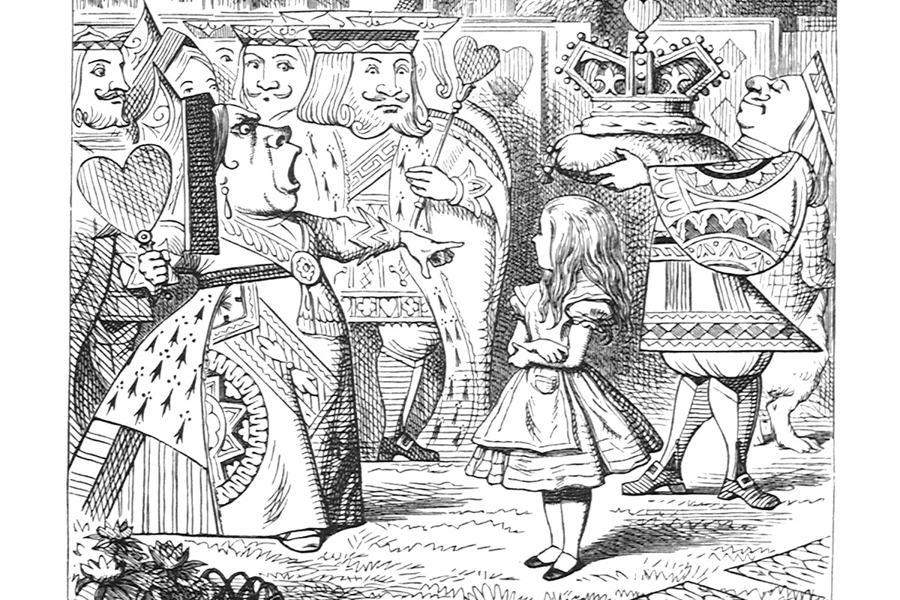
The exchange divides along the line this chapter measures. Alice's question is the lexicographer's: how many senses a word can carry. WordNet gives word 10 noun senses, master 10 and question 6, but definition only 2. Humpty Dumpty's answer is the mathematician's. A definition does not count the senses a word already has. It chooses one and holds the reader to it, “neither more nor less”. Chapter 4's translation keys and the Key Register apply that rule to this series' own letters. COMPUTED MODEL
Martin Gardner's Annotated Alice prints the passage in Carroll's own text: “When I use a word,” Humpty Dumpty said, in rather a scornful tone (the letter leaves out the comma). Gardner's note on it says that “Lewis Carroll was fully aware of the profundity in Humpty Dumpty's whimsical discourse on semantics”, and names the position: “Humpty takes the point of view known in the Middle Ages as nominalism”. For mathematics his warning is direct: “Even in logic and mathematics, where terms are usually more precise than in other subject matters, enormous confusion often results from a failure to realize that words mean ‘neither more nor less’ than what they are intended to mean.” He then shows that Carroll said it again himself, in earnest, on page 165 of his Symbolic Logic, a passage “straight from the broad mouth of Humpty Dumpty”. CITED
The same letter quotes the Mock Turtle's “different branches of Arithmetic—Ambition, Distraction, Uglification and Derision”. It does not spell out the pun, so the script measures it. Of the 24 ways to pair the four branches with addition, subtraction, multiplication and division, the one with the smallest total edit distance is the obvious one: Ambition–Addition, Distraction–Subtraction, Uglification–Multiplication, Derision–Division, at 12 letters against 16 for the next best. Its garden path, the one that “goes straight back to the house”, the letter reads as proof search: “Who among us, trying to prove some theorem, has not experienced this exact phenomenon?” It also repeats, and labels “possibly apocryphal”, the story that Queen Victoria asked for more of Dodgson's books and was sent one on geometry. COMPUTED
The book itself is now held, as Peter Zelchenko's replica of the 1865 edition, and the Mock Turtle's whole curriculum (ch. IX, pp. 142–146) can be checked. It lists thirteen subjects: Reeling and Writhing, the four branches of Arithmetic, “Mystery, ancient and modern, with Seaography”, “Drawling, Stretching, and Fainting in Coils”, and from the Classical master “Laughing and Grief”. For each one, the script finds the nearest name among the thirteen real subjects by edit distance, and it is the subject being punned on every time, 13 out of 13: reading, writing, addition, subtraction, multiplication, division, history, geography, drawing, sketching, painting in oils, Latin and Greek. The pun is always a small edit to the real name. COMPUTED
Then comes a sum. “Ten hours the first day,” the Mock Turtle says, “nine the next, and so on”, because, the Gryphon explains, “they lessen from day to day”. Alice extends the sequence: “Then the eleventh day must have been a holiday?” On day 11 the count reaches 0, after 55 hours in all. She presses on: “And how did you manage on the twelfth?” Day 12 would need −1 hours, and at that point the Gryphon closes the subject: “That’s enough about lessons.” Alice asks the mathematician's question, what the rule gives past the point where it stops making sense, and the conversation ends there. COMPUTED CITED
Gardner reads the scene the same way. His note 19 on the chapter says that “Alice's excellent question rightly puzzles the Gryphon because it introduces the possibility of mysterious negative numbers”, and he asks: “On the twelfth day and succeeding days did the pupils start teaching their teacher?” CITED
- P. Nogueira Grossi, "Towards a Predictive Architecture for Dictionary Entry Design", manuscript for the International Journal of Lexicography, v3 (June 2026) and v4 (this chapter).
- E. Petersen & C. Potts, Findings of EACL 2023, 490–511.
- F. Bond, M. Maziarz, T. Piotrowski & E. Rudnicka, IJL 37.2 (2024) 196–225, doi:10.1093/ijl/ecad033.
- C. Fellbaum (ed.), WordNet, MIT Press 1998; G. A. Miller et al., "A Semantic Concordance", HLT 1993.
- L. Schrieber, Letter to the Editor, Notices of the AMS 71(6) (June/July 2024), p. 704, doi:10.1090/noti2952. Held (the full issue).
- L. Carroll, Alice’s Adventures in Wonderland (1865), ch. IX, pp. 142–146, in P. Zelchenko’s digital replica of the first edition (BookVirtual). Held.
- M. Gardner, The Annotated Alice: The Definitive Edition (W. W. Norton, New York, 2000): Through the Looking-Glass ch. 6 and note 11; Wonderland ch. IX note 19. Held.
- A. Copestake, "Representing Lexical Polysemy", AAAI Technical Report SS-95-01 (1995), pp. 21–26. Held.
- S. Skoufaki & B. Petrić, "Exploring polysemy in the Academic Vocabulary List: A lexicographic approach", Journal of English for Academic Purposes 54 (2021), 101038, doi:10.1016/j.jeap.2021.101038. Held (accepted-manuscript copy).
Copestake's sense-extension families
Section 2's own table already tags chicken and lamb as "animal before meat (grinding)", but never says where that word comes from. It is Ann Copestake's (1995). She distinguishes constructional polysemy, a single sense contextually specialised, from sense extension, where one reading is derived from another by a named, repeatable rule: rabbit meaning the animal or its meat or fur, violin meaning the instrument or the musician. Sense extensions "often seem to fall into families": her example (2) gives rabbit three ways — "Sandy likes to eat rabbit" (animal → meat, meat-grinding), "Sandy likes to wear rabbit" (animal → fur/skin, fur/skin grinding), and "That stuff on the tarmac looks like rabbit" (physical object → substance, grinding) — naming meat-grinding and fur/skin-grinding as the two cases of a single general grinding rule. CITED
Read against §3 above, this says something specific about the two rows where prediction (ii) failed. Chicken's animal→meat split is Copestake's meat-grinding, by name. Book's physical-object→content split is a sense extension of the same general kind (Pustejovsky's qualia-based container/contents and object/content families, which C+B's framework, cited by Copestake, also covers), not an idiosyncratic exception. That does not change §3's result — the frequency reversal was measured, not predicted by this — but it does mean the two failing rows are named instances of a documented pattern, not two isolated surprises. MODEL
A frequency study, related but not the same question
Skoufaki & Petrić (2021) count polysemous lemmas in the Academic Vocabulary List against the Collins COBUILD dictionary and WordNet: 919 of 2,673 shared lemmas (34.38%) are polysemous, and dictionary/WordNet sense count correlates positively with corpus frequency in COCA-Academic. That is a different question from §3's: it asks whether words with more senses tend to be more frequent overall, not whether a given word's most frequent sense is its head sense. It does not close the "SemCor is small and dated" item noted in §4 above — it is a large, recent, purpose-built count, but of a different thing. CITED
Their own Highlights page and Abstract disagree with each other: the Highlights say "607 (65.05%)" of polysemous lemmas are in the 1,000 most frequent, the Abstract says "Most (66.05%)". The script checks the arithmetic: 607/919 = 66.05%, matching the Abstract. The Highlights bullet's own percentage is the one that does not reduce, a small error in their document, not something this page relies on for its own claims. COMPUTED