Saturno e a Fumaça O mesmo operador em dois domínios / One operator, two domains
A mesma álgebra de operadores que fixa o hexágono de Saturno governa como a fumaça de um incêndio florestal alcança os pulmões. Dois domínios distintos, uma única estrutura — e teoremas novos, verificados no núcleo Lean, em cada um.
The same operator algebra that fixes Saturn's hexagon governs how wildfire smoke reaches the lungs. Two distinct domains, one structure — with new, kernel-verified theorems in each.
Saturno: G→ponto fixo D₆ · Fumaça: G longe do equilíbrio · [porta, pontual] = 0
Uma tese, duas medidas / One thesis, two measurements
🇧🇷PortuguêsPrimário
O operador G = U∘F∘K∘C foi construído nos volumes anteriores como uma cadeia de quatro operações: Compressão (C), Constrição — o limiar — (K), Dobramento (F) e Desdobramento (U). Este capítulo faz uma afirmação mais forte do que qualquer analogia: que a mesma estrutura algébrica aparece, verificada no núcleo, em dois domínios físicos que nada têm em comum na superfície.
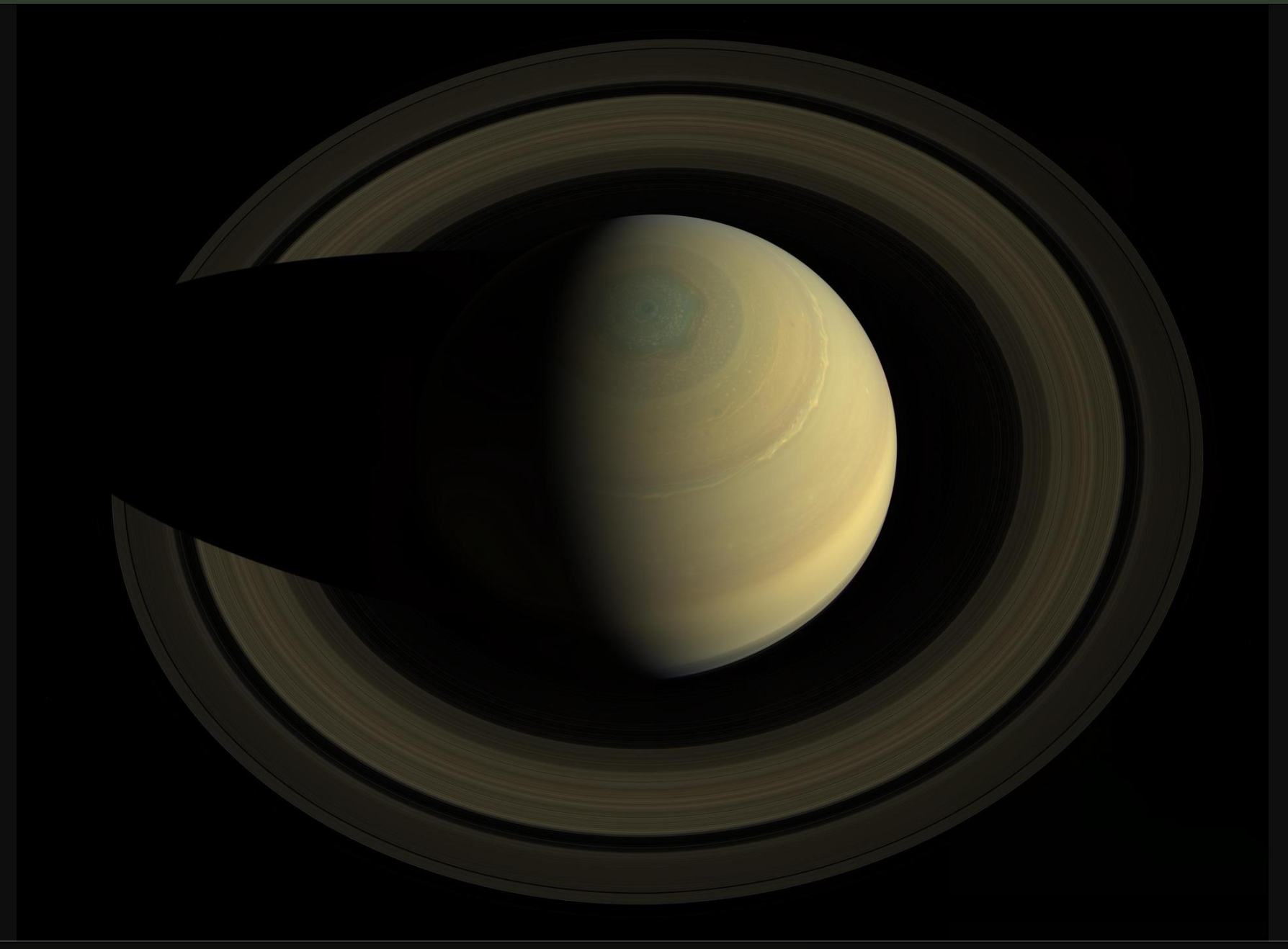
O primeiro é o hexágono de Saturno — um vórtice de número de onda seis, estável há mais de quarenta anos no polo norte do planeta. É o caso estável: G converge para um ponto fixo simétrico D₆.
O segundo é a fumaça transamericana — a pluma dos incêndios de Ontário que alcançou Nova York entre 13 e 19 de julho de 2026. É o caso transiente: a mesma cadeia, longe do equilíbrio, produzindo um campo de exposição que subiu vinte vezes e recuou em quarenta e oito horas.
A descoberta que une os dois é negativa e precisa: uma porta que age ponto a ponto não é o que faz a ordem importar. Uma porta 0/1 comuta exatamente com qualquer operação pontual; a dependência de ordem é sempre carregada pelo operador que transporta amplitude entre posições — nunca pela porta sozinha. Essa frase é o conteúdo inteiro deste capítulo, e está verificada no núcleo Lean em ambos os domínios.
🇬🇧EnglishTranslation
The operator G = U∘F∘K∘C was built in earlier volumes as a chain of four operations: Compression (C), Constraint — the threshold — (K), Folding (F) and Unfolding (U). This chapter makes a stronger claim than any analogy: that the same algebraic structure appears, kernel-verified, in two physical domains with nothing in common at the surface.
The first is Saturn's hexagon — a wavenumber-six vortex, stable for more than forty years at the planet's north pole. This is the stable case: G converges to a D₆-symmetric fixed point.
The second is the transamerican smoke — the plume from the Ontario fires that reached New York between 13 and 19 July 2026. This is the transient case: the same chain, far from equilibrium, producing an exposure field that rose twentyfold and receded within forty-eight hours.
The finding that unites them is negative and precise: a gate acting pointwise is not what makes order matter. A 0/1 gate commutes exactly with any pointwise operation; order-dependence is always carried by the operator that transports amplitude between positions — never by the gate alone. That sentence is the whole content of this chapter, and it is kernel-verified in both domains.
Seção 2 · Section 2
Saturno — o ponto fixo estável / the stable fixed point
🇧🇷PortuguêsPrimário
Modele o vórtice polar como amplitude sobre seis sextantes angulares, $\theta_k = k\pi/3$, $k=0,\dots,5$. Três operações agem sobre esse anel: a porta radial (um limiar 0/1 que age em cada sextante isoladamente), a não linearidade pontual (o termo $\lambda|\psi|^2\psi$), e o acoplamento angular — o termo $b\,r^6\cos(6\theta)$ do Hamiltoniano, que redistribui amplitude entre sextantes vizinhos.
Teoremas de Saturno · verificados no núcleo
(i) A porta radial comuta exatamente com o dobramento pontual, para todo estado. [VERIFICADO]
(ii) O acoplamento angular não comuta com a não linearidade pontual: no sextante 0, $1^3+1^3=2$, mas $(1+1)^3=8$. [VERIFICADO]
(iii) A rotação sêxtupla $R:\theta\mapsto\theta+\pi/3$ comuta com o acoplamento angular — a simetria D₆ do mecanismo — e o hexágono uniforme é o seu ponto fixo invariante. [VERIFICADO]
A correção importa. Uma versão anterior desta prova (Cap 7, Retorno Cristalino) afirmava que a porta radial não comutava com o dobramento pontual, e daí derivava a ordem. Isso era falso — a porta e o mapa pontual agem ambos sextante a sextante, e a sua ordem não pode importar. A dependência de ordem é real, mas mora no acoplamento angular. A conclusão D₆ sobrevive; a derivação foi refeita.
🇬🇧EnglishTranslation
Model the polar vortex as amplitude over six angular sextants, $\theta_k = k\pi/3$, $k=0,\dots,5$. Three operations act on this ring: the radial gate (a 0/1 threshold acting on each sextant in isolation), the pointwise nonlinearity (the $\lambda|\psi|^2\psi$ term), and the angular coupling — the $b\,r^6\cos(6\theta)$ Hamiltonian term that redistributes amplitude between neighbouring sextants.
Saturn theorems · kernel-verified
(i) The radial gate commutes exactly with the pointwise fold, for every state. [VERIFIED]
(ii) The angular coupling does not commute with the pointwise nonlinearity: at sextant 0, $1^3+1^3=2$, but $(1+1)^3=8$. [VERIFIED]
(iii) The sixfold rotation $R:\theta\mapsto\theta+\pi/3$ commutes with the angular coupling — the D₆ symmetry of the mechanism — and the uniform hexagon is its invariant fixed point. [VERIFIED]
The correction matters. An earlier version of this proof (Ch 7, Crystalline Return) claimed the radial gate did not commute with the pointwise fold, and derived order-dependence from that. It was false — gate and pointwise map both act sextant by sextant, and their order cannot matter. Order-dependence is real, but it lives in the angular coupling. The D₆ conclusion survives; the derivation was rebuilt.
A fumaça — o campo transiente / the transient field
🇧🇷PortuguêsPrimário
Modele a coluna atmosférica como amplitude sobre três camadas — superfície, meio, altura. As mesmas três operações reaparecem, com nomes físicos diferentes: a tampa (a inversão da camada de mistura, um limiar 0/1 na vertical), a perda pontual (deposição, agindo em cada camada isoladamente) e o transporte vertical (a mistura que move amplitude entre camadas).
Os dados são medidos, não modelados. Entre 13 e 19 de julho de 2026, o PM$_{2.5}$ à superfície na área metropolitana de Nova York subiu de $7{,}2$ para $148{,}3~\mu$g m$^{-3}$ — vinte vezes — atingindo o pico às 20:00 EDT de 16 de julho, exatamente quando a camada de mistura, medida por radiossondagem em Upton NY, colapsou de $565$ para $53$ metros. As duas grandezas, comparadas na mesma hora do dia, estão fortemente anticorrelacionadas ($r=-0{,}90$ em escala logarítmica, $n=7$).
Teoremas da fumaça · verificados no núcleo
T1 (diluição): a carga da coluna fixa, a concentração à superfície varia como $h^{-1}$ exatamente. Invocado aqui para proibir uma inferência — nenhum expoente pode ser ajustado aos dados, pois a carga não foi constante. [VERIFICADO]
T2 (comutação): a tampa comuta exatamente com a perda pontual, mas não com o transporte vertical. A dependência de ordem na exposição à superfície é carregada pelo transporte, nunca pela tampa. [VERIFICADO]
🇬🇧EnglishTranslation
Model the atmospheric column as amplitude over three layers — surface, mid, aloft. The same three operations reappear under different physical names: the lid (the mixed-layer inversion, a 0/1 threshold on the vertical), pointwise loss (deposition, acting on each layer in isolation), and vertical transport (the mixing that moves amplitude between layers).
The data are measured, not modelled. Between 13 and 19 July 2026, surface PM$_{2.5}$ across the New York metropolitan area rose from $7.2$ to $148.3~\mu$g m$^{-3}$ — twentyfold — peaking at 20:00 EDT on 16 July, exactly as the mixed layer, measured by Upton NY radiosonde, collapsed from $565$ to $53$ metres. The two quantities, compared at matched time of day, are strongly anticorrelated ($r=-0.90$ in log space, $n=7$).
Smoke theorems · kernel-verified
T1 (dilution): at fixed column burden, surface concentration varies as $h^{-1}$ exactly. Invoked here to forbid an inference — no exponent may be fitted to the data, since the burden was not constant. [VERIFIED]
T2 (commutation): the lid commutes exactly with pointwise loss, but not with vertical transport. Order-dependence in surface exposure is carried by transport, never by the lid. [VERIFIED]
Saturno adquire dados — o decágono / Saturn acquires data — the decagon
🇧🇷PortuguêsPrimário
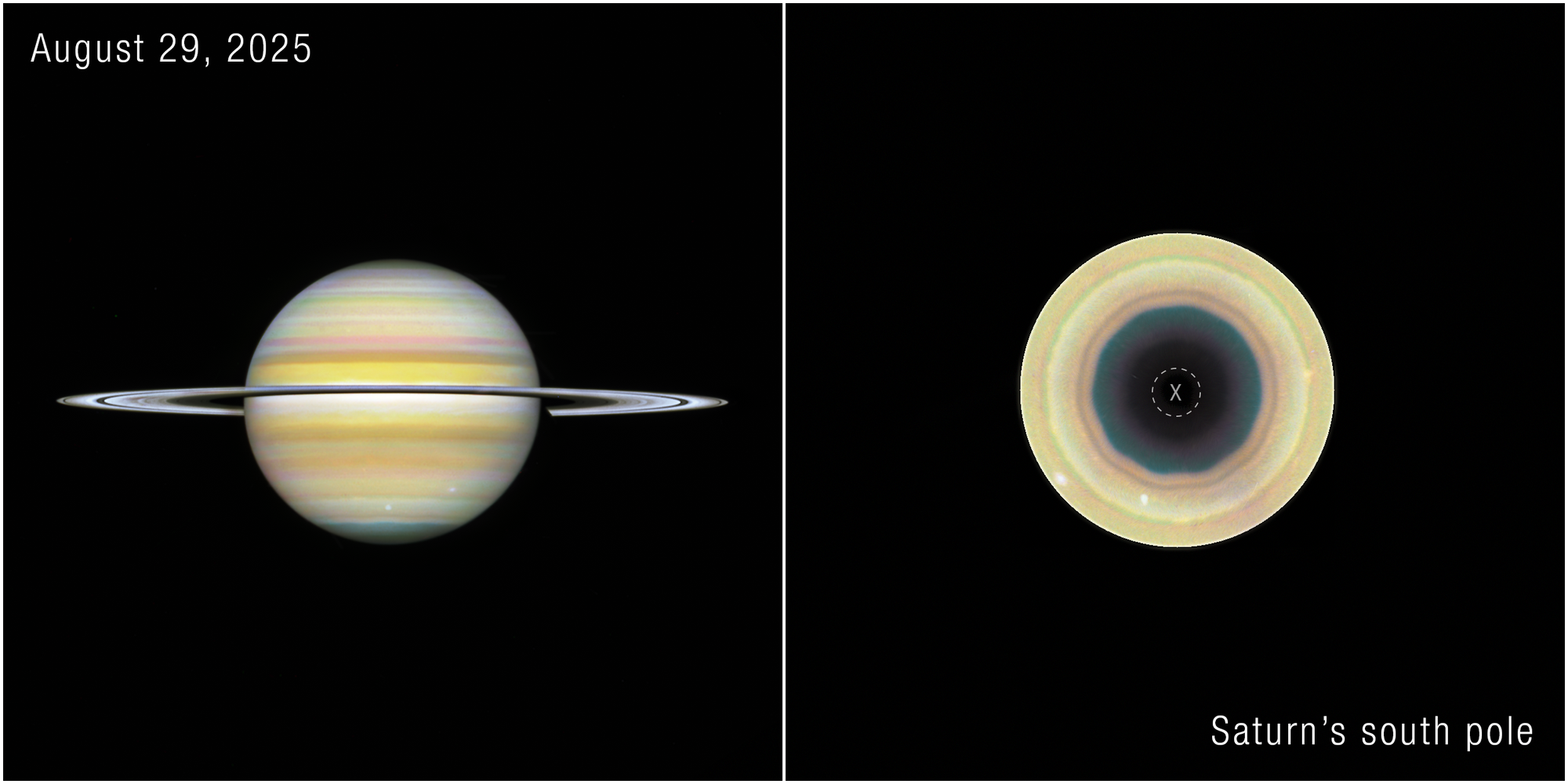
A Seção 2 encerrou com uma assimetria declarada: Saturno traz a simetria D₆ que a fumaça não tem; a fumaça traz os dados que Saturno não tem. Em 2 de setembro de 2026 essa frase deixou de ser verdadeira. Imagens do programa OPAL do Hubble revelaram um padrão de número de onda dez circundando o polo sul — o primeiro padrão poligonal regular observado no hemisfério sul do planeta.
O que importa não é que exista um segundo polígono. É que ele está se fortalecendo. O hexágono esteve presente em todas as observações por mais de quarenta anos: é um ponto fixo, e um ponto fixo não mostra a operação que o produziu. O decágono está se organizando agora, com registro desde 2023 e ainda em acumulação. É o operador agindo, não o seu resultado — que é precisamente o que o volume anterior não pôde medir.
O par polar · o que se estabeleceu
(iv) Sobre o refinamento comum de trinta setores, um padrão sêxtuplo tem período 5 e um décuplo tem período 3. Como $\gcd(5,3)=1$, um campo que carrega ambas as simetrias é constante. [VERIFICADO]
(v) Uma cascata de tríades ressonantes entre os números 6 e 10 não pode deixar a rede par: nenhum número de onda ímpar surge desse par. [VERIFICADO]
(vi) Geometria nodal em ambos os números de onda — os ângulos nodais são zeros de $\cos(6\theta)$ e $\cos(10\theta)$. [VERIFICADO]
O teorema (iv) proíbe a leitura mais tentadora, com uma ressalva que a primeira redação omitiu. Rotações de ordem 6 e de ordem 10 geram a rotação de ordem 30, de modo que um campo com as duas simetrias é invariante sob C₃₀: num anel de N setores tem período N/30. Em trinta setores isso se lê “constante”; em sessenta se lê “período dois”, e o campo alternante k mod 2 é a testemunha não constante. A forçagem à constância era artefato do refinamento mínimo, não fato sobre 6 e 10. O hexágono e o decágono continuam não sendo duas simetrias de um mesmo campo — porque tal campo exibiria trinta lados, e ninguém fotografou um triacontágono em Saturno. Não há, portanto, objeto D₆×D₁₀ unificado a exibir. Qualquer acoplamento entre os hemisférios teria de ser dinâmico, com um mecanismo de transporte nomeado, e não pode ser lido da aritmética dos números de onda. Isso permanece [ABERTO], e agora é aberto de forma demonstrável, não apenas por falta de investigação.
A explicação a bater continua sendo sazonal: Saturno cruzou o equinócio em 2025, e o jato polar sul pode estar se reorganizando sob a insolação em mudança, independentemente do norte. Nada aqui a enfraquece.
🇬🇧EnglishTranslation
Section 2 closed on a stated asymmetry: Saturn brings the D₆ symmetry the smoke lacks; the smoke brings the data Saturn lacks. On 2 September 2026 that sentence stopped being true. Hubble OPAL imagery revealed a wavenumber-ten pattern encircling the south pole — the first regular polygonal jet observed in the planet's southern hemisphere.
What matters is not that a second polygon exists. It is that it is strengthening. The hexagon has been present every time anyone looked, for more than forty years: it is a fixed point, and a fixed point does not show the operation that produced it. The decagon is organising now, with a record running back to 2023 and still accumulating. That is the operator acting rather than its result — which is precisely what the previous volume could not measure.
The polar pair · what is established
(iv) On the common refinement of thirty sectors, a sixfold pattern has period 5 and a tenfold pattern period 3. Since $\gcd(5,3)=1$, a field carrying both symmetries is constant. [VERIFIED]
(v) A resonant-triad cascade between wavenumbers 6 and 10 cannot leave the even lattice: no odd wavenumber arises from that pair. [VERIFIED]
(vi) Nodal geometry at both wavenumbers — the nodal angles are zeros of $\cos(6\theta)$ and $\cos(10\theta)$. [VERIFIED]
Theorem (iv) forbids the tempting reading, with a caveat the first draft left out. Rotations of order 6 and order 10 generate rotation of order 30, so a field carrying both is invariant under C₃₀: on a ring of N sectors it has period N/30. On thirty sectors that reads “constant”; on sixty it reads “period two”, and the alternating field k mod 2 is the non-constant witness. The forcing-to-constant was an artefact of the minimal refinement, not a fact about 6 and 10. The hexagon and the decagon are still not two symmetries of one field — because such a field would show thirty sides, and nobody has photographed a triacontagon on Saturn. There is therefore no unified D₆×D₁₀ object to exhibit. Any coupling between the hemispheres would have to be dynamical, with a named transport mechanism, and cannot be read off the arithmetic of the wavenumbers. That remains [OPEN], and is now demonstrably open rather than merely uninvestigated.
The explanation to beat is still seasonal: Saturn passed equinox in 2025, and the southern polar jet may be reorganising under changing insolation, independently of the north. Nothing here weakens it.
Norte · North. O hexágono, visto pela Cassini: a região polar teal, presente em toda observação por mais de quarenta anos. Um ponto fixo. / The hexagon, seen by Cassini: the teal polar region, present in every observation for more than forty years. A fixed point.
Cassini · NASA/JPL-Caltech/Space Science Institute. Identificador PIA não confirmado / PIA identifier not confirmed.Sul · South. O decágono, Hubble/OPAL, 29 de agosto de 2025: projeção polar sul, a região escura de dez lados. Está se fortalecendo. / The decagon, Hubble/OPAL, 29 August 2025: south polar projection, the ten-sided dark region. It is strengthening.
NASA · ESA · STScI. Programa OPAL / OPAL programme.
As duas imagens são o teorema (iv) em forma visual: dois anéis distintos, em hemisférios distintos, com números de onda distintos. Não é um campo com duas simetrias — é o único arranjo que a aritmética permite. / The two images are theorem (iv) in visual form: two distinct rings, in distinct hemispheres, carrying distinct wavenumbers. Not one field with two symmetries — the only arrangement the arithmetic allows.
O que uma verificação estabelece / What a verification establishes
🇧🇷PortuguêsPrimário
É preciso ser exato sobre o que estes teoremas fazem e o que não fazem. Eles são afirmações sobre modelos finitos — um anel de seis sextantes, uma coluna de três camadas — verificadas pelo núcleo Lean com auditoria de axiomas limpa. Não são afirmações sobre Saturno, nem sobre a atmosfera. O que provam é que, dentro do modelo, a ordem é carregada pelo transporte e não pela porta.
No caso da fumaça, a correlação medida é consistente com o aprisionamento controlado pela tampa, mas não demonstra causalidade: uma estagnação sinótica produz tanto uma camada rasa quanto pouca ventilação, e a retroalimentação fumaça–camada-limite corre nos dois sentidos. A amostra é de sete pares. Isto está marcado como aberto, não resolvido.
O que este capítulo estabelece de verdade é mais modesto e mais duro: o arcabouço GTCT, tomado como álgebra de operadores, aplica-se a dois domínios distintos, e em cada um produz teoremas novos que o núcleo aceita. Saturno traz a simetria D₆ que a fumaça não tem; a fumaça traz dados que Saturno não tem. A álgebra é a mesma. Isso, e apenas isso, é o que se afirma.
🇬🇧EnglishTranslation
One must be exact about what these theorems do and do not do. They are statements about finite models — a six-sextant ring, a three-layer column — verified by the Lean kernel with clean axiom audits. They are not statements about Saturn, nor about the atmosphere. What they prove is that, within the model, order is carried by transport and not by the gate.
For the smoke, the measured correlation is consistent with lid-controlled trapping but does not demonstrate causation: synoptic stagnation produces both a shallow layer and poor ventilation, and the smoke–boundary-layer feedback runs in both directions. The sample is seven pairs. This is marked open, not resolved.
What this chapter genuinely establishes is more modest and harder: the GTCT framework, taken as an operator algebra, applies to two distinct domains, and in each produces new theorems the kernel accepts. Saturn brings the D₆ symmetry the smoke lacks; the smoke brings data Saturn lacks. The algebra is the same. That, and only that, is the claim.
Etiquetas de status / status tags
[VERIFICADO/VERIFIED] núcleo Lean · [DADOS/DATA] medido, fonte citada · [MODELO/MODEL] segue das hipóteses · [ABERTO/OPEN] não estabelecido. Nenhuma afirmação muda de etiqueta.