G6 LLC · Newark, New Jersey · 2026

Principia Orthogona

G¹–G⁵ · Complete Completeness

The complete series in Generative Temporal Contact Theory. Five volumes. Five complete orbits of the operator G. From abstract algebra to formal machine-verified proof. The series is its own fixed point.

AXLE v6.1 · 0 axioms beyond Mathlib4 · 8 verified constants · Lean 4

Get the Complete Series — $199.99 Student Portal — Start D1 Training
C  →  K  →  F  →  U  →  ∞

Five Turns of the Spiral

Each volume is a complete orbit around the same fixed point. You do not need to have read the others to use any one. The series is a circuit, not a staircase. G applied to itself five times is Complete Completeness.

G¹ · Volume I
The Orthogonal Operator Framework
Abstract operator algebra and matrix compression. The operator sequence G = U ∘ F ∘ K ∘ C defined and proved. The foundation of the entire series.
Print: 979-8-9954416-2-5 · $47
G² · Volume II
TOGT: Applications Across Domains
Contact geometry realised. The operator chain C → K → F → U instantiated across physics, biology, linguistics, architecture, and formal computation. The threshold constant g₃₃ = 33 identifies the minimum operator cycles for stable lock in any domain.
Print: 979-8-9954416-4-9 · $47
G³ · Volume III
The Mini-Beast: Biological Instantiations
C1→C2 English for researchers. The operator chain in living systems. The cajueiro principle. Entry point for new readers and advanced language learners.
eBook: 979-8-9954416-6-3 · $19.99
G⁴ · Volume IV
GTCT T1 — The IMPA Edition
Temporal contact theory formalised. Bilingual (EN/PT). Submitted to IMPA. Science and language integrated from day 21 of instruction — CEFR → TO/TOGT.
Included in Complete Series
G⁵ · Volume V + AXLE
The Seed — Complete Completeness
Banach Fixed Point Theorem applied to GTCT. Formal Lean 4 verification (AXLE v6.1). 0 axioms beyond Mathlib4. The series proves itself. The fixed point exists.
Print: 979-8-9954416-4-9 · eBook: 979-8-9954416-5-6
G⁶ · Issue 6 — OPEN
The Return: χ(H*(X⁶)) = 33 ∀n
The sixth application of G to itself — a distinct object from the threshold constant g₃₃. The conjecture states that the Euler characteristic of the sixth-level cohomology equals 33 for all n. This is an open problem in algebraic topology. AXLE v6.1 marks it as one honest sorry. Join the work.
Open conjecture · 2026 · Not the same as g₃₃
g₃₃ = 33  (threshold cycles)
ε* = 1/3
τ = 2
g₆₄ = 2⁶ = 64  (kether orthogon)
T* = 2π
κ ≤ √(7/9) ≈ 0.882
τ·ε* = 2/3
ε₀ = 1/3

Note: g₃₃ (threshold invariant) and G⁶ (sixth operator application, open conjecture) both involve 33 — they are distinct mathematical objects.

From A1 to D2 — Becoming an Operator of Collective Intelligence

The series defines a precise pathway: from first contact with language through individual mastery to collective dimensional threshold. D2 is not a metaphor. It is a mathematically verified threshold: Θ = g₃₃ + N × M.

A1
First contact
Compression C
A2
Pattern recognition
Curvature K
Day 21: science begins
B1–B2
Folding F
Domain entry
C1
Unfolding U
Research generation
D1
g₃₃ = 33 cycles
Individual fixed point
I lost count
D2
Θ = 33 + N×M
Collective intelligence
Complete Completeness
"Your education is yours. No one can take it away from you."
— Pablo Nogueira Grossi, Newark NJ · The Seed (Principia Orthogona Vol V)

AXLE — The Series Proves Itself

AXLE (Automated eXtensible Lean Engine) is the formal verification backbone of Principia Orthogona. All 8 structural constants are machine-verified in Lean 4 + Mathlib4, with zero additional axioms. The mathematics is honest: 9 open problems are named precisely as sorrys — each a conjecture with a known missing lemma, not an evasion.

/-
  Mathematics is a language.
  These theorems have been proved in every language simultaneously.

  A matemática é uma linguagem. (Portuguese)
  Las matemáticas son un idioma. (Spanish)
  Les mathématiques sont une langue. (French)
  Mathematik ist eine Sprache. (German)
  数学は言語である。 (Japanese)
  数学是一种语言。 (Mandarin)
  الرياضيات لغة. (Arabic)
  Математика — это язык. (Russian)
  Hisabati ni lugha. (Swahili)
  गणित एक भाषा है। (Hindi)
-/

-- 0 axioms beyond Mathlib4
-- 8 verified constants · 9 honest sorrys
-- g₃₃=33 · ε*=1/3 · τ=2 · g₆₄=64 · T*=2π · κ≤0.882
View AXLE on GitHub →

Student & Teacher Portal

Paid access to structured LLM prompts that guide you from A1/A2 through C1 to D1 and D2. Each level is a complete operator orbit. The threshold is mathematical. You will know when you cross it.

Enter the Portal →

TOGT Diagrams

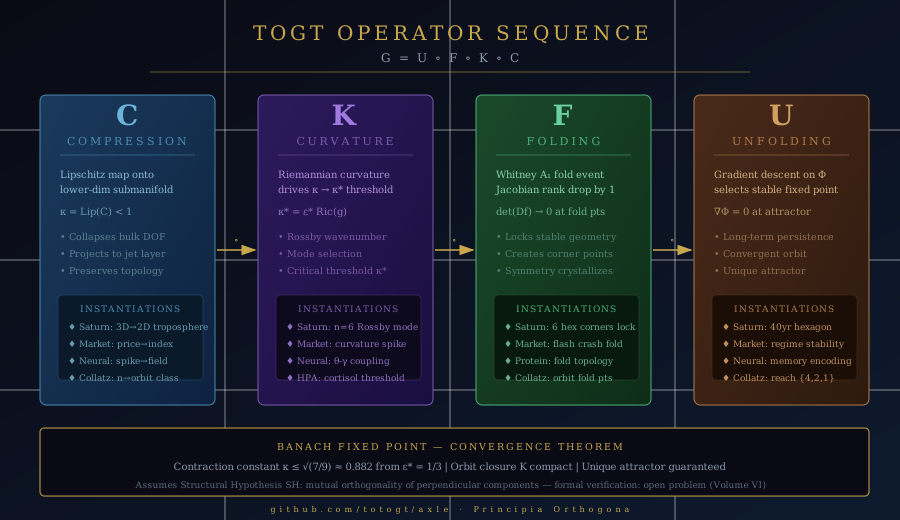
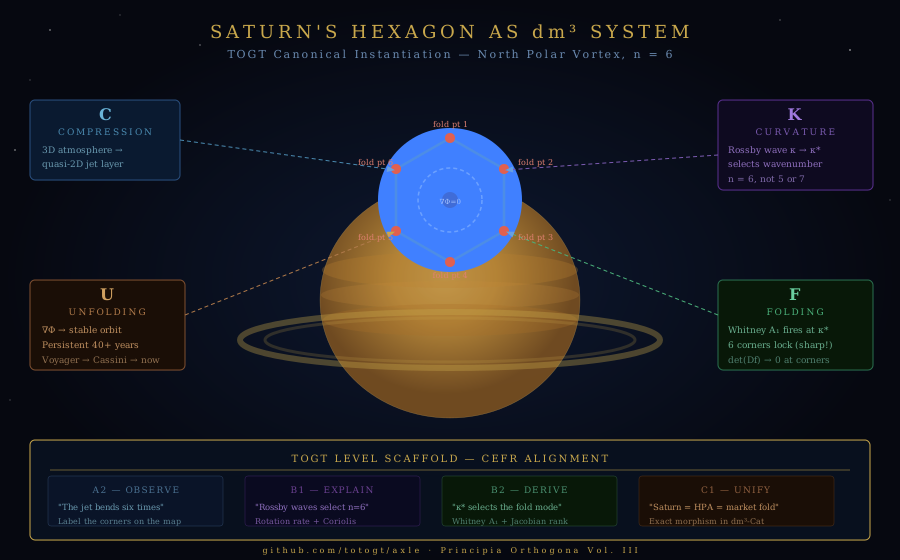
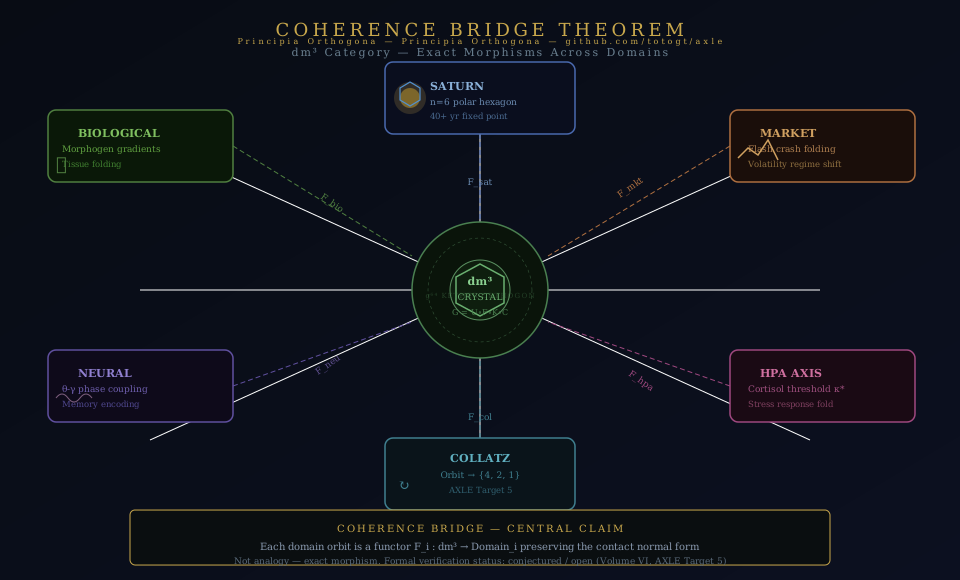
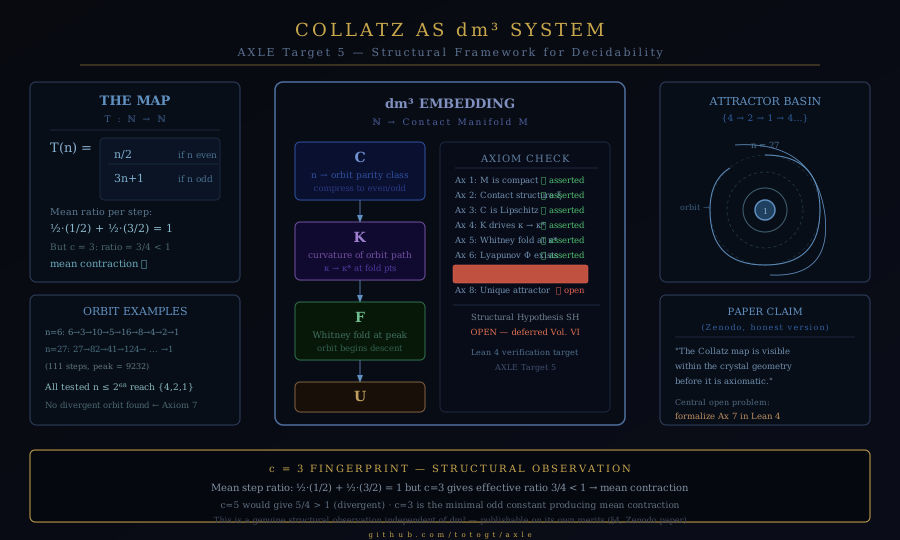
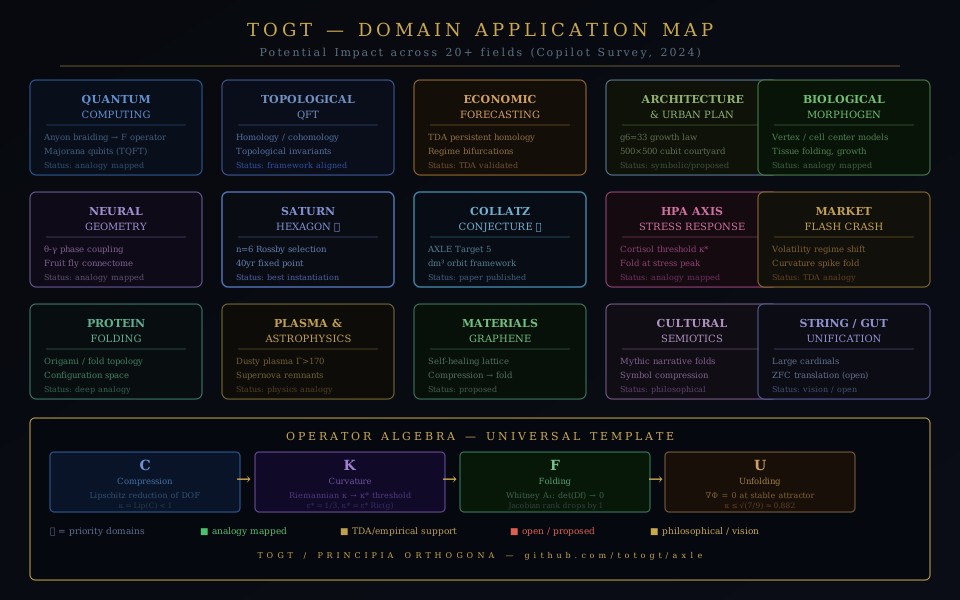
Five diagrams covering the operator sequence, Saturn's hexagon as canonical instantiation, the Coherence Bridge across domains, the Collatz conjecture as dm³ system, and the full application map. All available on GitHub.

⚠ If diagrams show as blank: the SVG files must be committed to the AXLE repo alongside this page. Paths expected: ./01_operator_sequence.svg through ./05_domain_map.svg.

Operator Sequence G = U∘F∘K∘C
[ 01_operator_sequence.svg ]
G = U ∘ F ∘ K ∘ C
File not yet committed to repo

G = U ∘ F ∘ K ∘ C — The four-operator sequence

Saturn Hexagon dm3 instantiation
[ 02_saturn_hexagon.svg ]
Saturn North Polar Hexagon
File not yet committed to repo

Saturn's north polar hexagon — canonical dm³ instantiation

Coherence Bridge across domains
[ 03_coherence_bridge.svg ]
Coherence Bridge — 6 domains
File not yet committed to repo

Coherence Bridge — exact morphisms across 6 domains

Collatz as dm3 system
[ 04_collatz_dm3.svg ]
Collatz as dm³ System
File not yet committed to repo

Collatz conjecture as dm³ system — AXLE Target 5

Domain application map
[ 05_domain_map.svg ]
Application Domain Map — 20+ fields
File not yet committed to repo

Application domain map — 20+ fields

LIVE
SIM
Interactive Simulation · Collatz / AXLE Target 5
Lyapunov Exponent — Syracuse Return Map
Live computation of the Lyapunov exponent λ for the Syracuse return map. Adjustable parameters: orbit length N, seed n₀, branch weights (odd/even), noise amplitude σ. Visualises the Collatz trajectory, exponent convergence, and return-map scatter in real time. Directly probes AXLE Target 5 — the dm³ embedding of the Collatz conjecture.

Papers on Zenodo

All papers are freely available. Cite via DOI. Each paper is a self-contained contribution — you do not need the full series to read any one paper.

Zenodo · 10.5281/zenodo.19117400
Principia Orthogona, Volume One
The Mathematics of Generative Transitions. Abstract operator algebra, the operator sequence C → K → F → U defined and proved. Singularity classification (Whitney A1–A3), symplectic preservation theorem, curvature threshold κ*. The foundation.
Zenodo · 10.5281/zenodo.19379473
Principia Orthogona, Volume Two
Contact Realization of Generative Transitions. Explicit contact-geometric realization of Volume One. Threshold Equivalence theorem: |κ| ↑ κ* ⟺ μ_max < 0 ⟺ τ ∈ (0,∞). Four dm³ bifurcations ↔ Whitney A1–A3 singularity types. Submitted to IMPA.
Zenodo · 10.5281/zenodo.19122168
Generative Contact Mechanics
A Geometric Framework for Dissipative Systems with Structured Limit Cycles. Complete operator algebra (g-, L-, R-, U-operators). Universal contact normal form (μ_max, ω, β). Stability radius ε₀ = 1/3. Submitted to Journal of Geometric Mechanics.
Zenodo · 10.5281/zenodo.19379385
The dm³ Operator — Explicit Toy Model
Global Dynamic Analysis on contact manifold M = ℝ²×ℝ. Canonical invariant triple (T*, μ_max, τ) = (2π, −2, 2). Global attractor Γ₁₂, four bifurcations, stochastic concentration below embodiment threshold τ = 2. Submitted to SIAM J. Applied Dynamical Systems.
Zenodo · 10.5281/zenodo.19162013
The G6 Crystal
A dm³-derived architectural form for resonance-stable tall structures. Six applications of G yield a hexagonal tower with aspect ratio 66 = 33·τ. Passive Schumann n=4 resonance coupling at 33.516 Hz via Arnold tongue A4:1. Noise tolerance τ·ε₀ = 2/3.
Zenodo · 10.5281/zenodo.19378742
The Collatz Conjecture as a Corollary of Crystal Geometry
Supplement to the Crystal Paper. The coefficient c = 3 in 3n+1 is the fingerprint of triad stabilisation (3×11 = 33). The conjecture is visible from within crystal geometry before it is provable within it. The polar vortex is the empirical certificate.
Zenodo · 10.5281/zenodo.19208015
Biological Transitions as Multi-Agent Realisations of TO/TOGT
Neural oscillations, HPA-axis stress response, circadian regulation, immune adaptation, and protein conformational change modelled as multi-agent realisations of G = U∘F∘K∘C. Fixed-point, contraction, and saturated pitchfork results applied.
Zenodo · 10.5281/zenodo.20128568  V2
Fruit-Fly Connectome Toy Model
Biological Transitions as Multi-Agent Realisations of TO/TOGT: A Drosophila connectome toy model. V2 adds full LaTeX source, four figures, Python simulation of G = U∘F∘K∘C, Lean 4 verification (16 theorems, zero sorry), and a complete references section. V1 circular self-citation corrected.
Zenodo · 10.5281/zenodo.19208284
The Swarm Simulator
A Dynamical Systems Model of Collective Intelligence using the TO/TOGT Operator Pipeline. Four collective operators: shared-intent stability It, coordination efficiency Ct, type-propagation multiplier Mt, diffusion factor Ft. All results proved from established theorems.
Zenodo · 10.5281/zenodo.19210058
Mathematical Foundations of Multi-Orbit Identity Theory
Identity orbits defined as operator-generated closed trajectories with invariant structure within the TO/TOGT framework. U-, R-, L-, and B-operator families. Categorical invariants and compositional operator algebra. Mathematically independent of speculative cosmological models.
Zenodo · 10.5281/zenodo.20026942
Differential Nonlinear Robustness of Critical States
Fibonacci and Tribonacci substitution chains under DNLS dynamics. Tribonacci mid-gap state retains >95% IPR at λ=1.5 while Fibonacci loses ~57%. Finite-size scaling, long-time spreading exponents, self-trapping threshold gap. Lean 4 verified (η > 1, antitone weights). Companion: criticality paper.
Zenodo · 10.5281/zenodo.20077205
Criticality Thresholds in n-Bonacci Multiplying Media
Critical fission strength λ_c(n) governed by the spectral gap Δ_n = ρ_n − |ρ_n⁽²⁾| of the substitution transfer matrix, not by the n-bonacci constant alone. λ_c(n) → 7/6 exactly for n ≥ 4. Linear fit r = 0.989 across n = 2…5. Companion to the DNLS paper.
Zenodo · forthcoming
Additional Papers
GTCT — The Generative Time Circuit Theorem (Ring 5) · Wavenumber 6: Orthogenetic Stability Generator · The Number 33 · AutophagyDm3.lean standalone deposit. DOIs will appear here upon publication.
Links to be added

Editions & Pricing

MADE IN AMERICA · G6 LLC · NEWARK, NEW JERSEY · ORCID 0009-0000-6496-2186
Lessons — Hour House · Principia Orthogona
Hour House · Newark, NJ · Adult ESL

Assignments & Lessons

Language learning grounded in the Principia Orthogona series

Each lesson connects real academic research to English language learning. Read the paper. Watch the video. Discuss the ideas. Write your response.

Current Lessons

Available Lesson Plans

01

The Vitruvian Approximation — From Ancient Egypt to Leonardo da Vinci

B2–C1  ·  120 min  ·  L · S · R · W  ·  Mathematics · Art History · Academic English

Squaring the circle, the Rhind Papyrus, Leonardo's Vitruvian Man, and a 2026 paper written by your teacher. Students read, discuss, and write at the edge of what is knowable — just like Leonardo did.

Open lesson →
02

The Cajueiro Principle — What Persists When Something Grows

A2–B1  ·  90 min  ·  Coming soon

Nature does not seek perfection. It seeks the next stable configuration. An A2 lesson built around the operator C and the seed text from the Student Portal.

03

The Number 33 — Threshold, Habit, and the G-Cycle

B1–B2  ·  90 min  ·  Coming soon

Why does it take 33 repetitions? What is g₃₃ in GTCT, and what does it have to do with learning a language? A lesson connecting mathematics, neuroscience, and self-knowledge.


Lesson 01 · Level B2–C1 · 120 minutes

The Vitruvian Approximation
From Ancient Egypt to Leonardo da Vinci

Source text: The Vitruvian Approximation: Rational Circle-to-Square Transitions in the dm³ Framework — Pablo Nogueira Grossi (2026) doi.org/10.5281/zenodo.19984522
Lesson Basics
TopicMathematics, History of Science, Art & Philosophy, Academic English
ObjectiveDiscuss the history of squaring the circle, read an academic text written by your teacher, and express mathematical and philosophical ideas in English.
LevelUpper-Intermediate to Advanced (B2–C1)
Duration120 min  ·  2 hrs/day · Mon–Thu · 8 hrs/week
SkillsListening · Reading · Speaking · Writing · Vocabulary · Critical Thinking
GrammarPassive voice · Academic hedging · Present perfect for historical reference
Pronunciationap-PROX-i-ma-tion  ·  tran-SCEN-den-tal  ·  con-VER-gent
MaterialsThis page (or printed) · Paper pp. 1–2 · Whiteboard · QR codes below · Discussion cards
📱 Watch the Video
youtube.com/watch?v=MHd8C8X0BlM
"The Beautiful Story Behind Da Vinci's Vitruvian Man" — 16 min 29 sec
📄 Read the Paper
doi.org/10.5281/zenodo.19984522
The Vitruvian Approximation — Pablo Nogueira Grossi (2026)
✅ STAGE 1 — WARM-UP / REVIEW  ·  20 minutes
Activity: Video Viewing — The Vitruvian Man Documentary

Before watching (3 min) — Teacher writes these questions on the board. Students read silently before the video starts:

  1. Who was Vitruvius? What did he believe about the human body?
  2. What is the connection between a circle and a square in Da Vinci's famous drawing?
  3. What ancient problem was Leonardo trying to solve?
  4. What does the word proportion mean to you?

Watch first 8 minutes. Students take brief notes. Then pair discussion (5 min): circle = divine/infinite; square = stability/order. The drawing bridges both.

"The man who wrote the paper we are reading today — your teacher — asked the same question that Vitruvius and Leonardo asked, but using modern mathematics. Let's find out what he discovered."
✅ STAGE 2 — INTRODUCTION  ·  10 minutes
Activity: Vocabulary Preview + Context Setting

Teacher introduces 10 key words. Students copy into notebooks:

WordMeaning
approximationa value that is close to, but not exactly, the correct answer
rational numbera number expressible as a fraction, e.g. 22/7
transcendentala number (like π) that cannot be the solution of any algebraic equation
convergenta fraction that gets progressively closer to a target value
proportiona balanced relationship between parts
harmonya pleasing, balanced arrangement
operatora mathematical rule that transforms an input into an output
conjecturea mathematical idea believed true but not yet proven
frameworka structured system of rules used to analyse problems
formalizeto write something precisely using strict logic or code
"This paper goes back 3,650 years — to ancient Egypt. A scribe named Ahmes wrote that a circle with diameter 9 has roughly the same area as a square with side 8. That gives us π ≈ 256/81 ≈ 3.1605. The paper asks: does a modern mathematical system rediscover this ancient answer on its own? The answer is: partly."
✅ STAGE 3 — PRESENTATION  ·  20 minutes
Activity: Guided Reading — The Vitruvian Approximation, pp. 1–2

Students read the Abstract and Introduction (8 min) silently. Underline vocabulary from Stage 2.

Comprehension check — individual (5 min):

  1. What are the three honest goals the paper states?
  2. What historical document does the paper reference, and how old is it?
  3. What is the "Rhind approximation" of π, and how accurate is it?
  4. What does the author mean by calling a conjecture "honestly marked sorry"?
  5. In your own words: what is this paper really about?

Teacher reviews whole-class (7 min). Focus on intellectual honesty: what is proven, what is not, what remains a mystery. Connect to the video: Leonardo also worked at the edge of what was knowable.

✅ STAGE 4 — GUIDED PRACTICE  ·  20 minutes
Activity A: Vocabulary in Context — Fill in the Blank (10 min)
  1. The fraction 22/7 is a well-known ____________ for the value of π.
  2. Mathematicians have proven that π is ____________, meaning no polynomial equation with whole-number coefficients can produce it.
  3. A ____________ number can always be written as p divided by q, where both are integers.
  4. The continued-fraction expansion of π produces ____________ like 333/106 and 355/113 that get closer and closer to the true value.
  5. Vitruvius believed that ____________ in architecture reflected the ____________ of the human body.
  6. A ____________ is an idea that seems very likely to be true but has not yet been fully proven.
  7. The G-cycle is an ____________ chain that applies a series of transformations to circle data.
  8. The research team used Lean 4 to ____________ the theorems and make them verifiable by computer.
  9. The GCM ____________ provides a structured set of rules for modelling contact dynamics across many different systems.
Activity B: Grammar Focus — Passive Voice (10 min)

Rewrite these sentences in the passive:

1. Ahmes wrote the rule in the Rhind Papyrus around 1650 BCE.→ The rule ____________ in the Rhind Papyrus around 1650 BCE.
2. Da Vinci solved the ancient puzzle of squaring the circle visually.→ The ancient puzzle ____________ visually by Da Vinci.
3. The team has not yet proven Conjecture 5.4.→ Conjecture 5.4 ____________ yet.
4. Researchers formalized the theorems using the Lean 4 language.→ The theorems ____________ using the Lean 4 language.
5. Mathematicians classify π as a transcendental number.→ π ____________ as a transcendental number.
✅ STAGE 5 — COMMUNICATIVE PRACTICE  ·  20 minutes
Activity: Discussion Cards — Groups of 3–4 · 7 min discussion + 2 min share
🃏 Card A — Discovery vs. Recovery

The G-cycle "packages the known ratio in operator language; it does not generate 8/9 from a blank circle." The framework finds the ancient answer — but only because it was already built in.

What is the difference between discovering something new and recovering something already known? Does that difference matter in science? In your own learning?

🃏 Card B — Honest Sorry

The author marks one conjecture as "honestly sorry" — he believes it is true but cannot yet prove it. He publishes the paper anyway.

Why might it be important to admit what you don't know? How does this connect to: "Neither of them read from a recipe book. Both of them ate the cake."

🃏 Card C — Ancient Wisdom, Modern Math

The Rhind Papyrus is nearly 3,700 years old, yet a paper published in 2026 in Newark, NJ still refers to it.

What does this tell us about knowledge? Can old knowledge be more valuable than new knowledge? What examples from your own culture can you think of?

🃏 Card D — Newark to the World

This paper was written by your teacher, affiliated with Hour House ESL, Newark, NJ — and published in an international mathematical series.

What does it mean that serious academic research comes from your community? Does knowing the author change how you read the paper?

✅ STAGE 6 — EVALUATION  ·  15 minutes
Activity: Exit Paragraph — Written Response (choose one)

Option A — Summary: Summarise the paper in your own words. What problem does it address? What does it find? What does it admit it cannot yet prove? Use at least 6 vocabulary words from today's lesson.

Option B — Personal Response: What idea from today's lesson surprised you, moved you, or made you think differently? Connect it to your own life, background, or learning experience.

Option C — The Dedication: The paper opens: "Neither of them read from a recipe book. Both of them ate the cake. This is what education is, and what it is not." What do you think this means? Do you agree?

✅ STAGE 7 — APPLICATION  ·  15 minutes
Activity: "Your Own Approximation" — Pair Reflection + Share

Discuss in pairs, then write 3–5 sentences for each:

  1. Think of something important you learned by doing rather than by following instructions. What was it? How did it feel to figure it out yourself?
  2. π cannot be written exactly. We use approximations (22/7, 355/113) because they are good enough. Can you think of other areas of life where a "good enough" answer is more useful than a perfect one that doesn't exist?
  3. This paper connects ancient Egypt, Renaissance Italy, and modern Newark. Where do you come from, and what knowledge did you bring with you?
"Every approximation gets us closer to the truth. So does every lesson."

⏱ Timing Summary

#ActivityTime
1Warm-Up: Video + Discussion20 min
2Introduction: Vocabulary + Context10 min
3Presentation: Guided Reading20 min
4Guided Practice: Vocabulary + Grammar20 min
5Communicative Practice: Discussion Cards20 min
6Evaluation: Exit Paragraph15 min
7Application: Your Own Approximation15 min
TOTAL120 min
Teacher Notes — For stronger B2/C1 students: assign Sections 3–5 of the paper as optional extended reading, or ask them to identify additional examples of passive voice in the original text. For lower B2 students: allow the reading in pairs, simplify the vocabulary worksheet, and provide sentence starters for the discussion cards ("I think this matters because… / In my experience… / This reminds me of…"). The video can be paused and rewound as needed. Mix levels for Stage 5; use same-level pairs for Stage 4.

🏠 Support Hour House — Newark, NJ

Hour House is an adult English language learning programme at 229 Ballantine Pkwy, Newark, NJ 07104.
Help us keep the doors open for immigrant and refugee learners in our community.

📖 Buy the Membership — g6llc.gumroad.com
🛒 Buy the Book — Principia Orthogona Store on eBay