| Lesson Basics |
|---|
| Topic | Mathematics, History of Science, Art & Philosophy, Academic English |
| Objective | Discuss the history of squaring the circle, read an academic text written by your teacher, and express mathematical and philosophical ideas in English. |
| Level | Upper-Intermediate to Advanced (B2–C1) |
| Duration | 120 min · 2 hrs/day · Mon–Thu · 8 hrs/week |
| Skills | Listening · Reading · Speaking · Writing · Vocabulary · Critical Thinking |
| Grammar | Passive voice · Academic hedging · Present perfect for historical reference |
| Pronunciation | ap-PROX-i-ma-tion · tran-SCEN-den-tal · con-VER-gent |
| Materials | This page (or printed) · Paper pp. 1–2 · Whiteboard · QR codes below · Discussion cards |
📱 Watch the Video
youtube.com/watch?v=MHd8C8X0BlM
"The Beautiful Story Behind Da Vinci's Vitruvian Man" — 16 min 29 sec
📄 Read the Paper
doi.org/10.5281/zenodo.19984522
The Vitruvian Approximation — Pablo Nogueira Grossi (2026)
Activity: Video Viewing — The Vitruvian Man Documentary
Before watching (3 min) — Teacher writes these questions on the board. Students read silently before the video starts:
- Who was Vitruvius? What did he believe about the human body?
- What is the connection between a circle and a square in Da Vinci's famous drawing?
- What ancient problem was Leonardo trying to solve?
- What does the word proportion mean to you?
Watch first 8 minutes. Students take brief notes. Then pair discussion (5 min): circle = divine/infinite; square = stability/order. The drawing bridges both.
"The man who wrote the paper we are reading today — your teacher — asked the same question that Vitruvius and Leonardo asked, but using modern mathematics. Let's find out what he discovered."
Activity: Vocabulary Preview + Context Setting
Teacher introduces 10 key words. Students copy into notebooks:
| Word | Meaning |
|---|
| approximation | a value that is close to, but not exactly, the correct answer |
| rational number | a number expressible as a fraction, e.g. 22/7 |
| transcendental | a number (like π) that cannot be the solution of any algebraic equation |
| convergent | a fraction that gets progressively closer to a target value |
| proportion | a balanced relationship between parts |
| harmony | a pleasing, balanced arrangement |
| operator | a mathematical rule that transforms an input into an output |
| conjecture | a mathematical idea believed true but not yet proven |
| framework | a structured system of rules used to analyse problems |
| formalize | to write something precisely using strict logic or code |
"This paper goes back 3,650 years — to ancient Egypt. A scribe named Ahmes wrote that a circle with diameter 9 has roughly the same area as a square with side 8. That gives us π ≈ 256/81 ≈ 3.1605. The paper asks: does a modern mathematical system rediscover this ancient answer on its own? The answer is: partly."
Activity: Guided Reading — The Vitruvian Approximation, pp. 1–2
Students read the Abstract and Introduction (8 min) silently. Underline vocabulary from Stage 2.
Comprehension check — individual (5 min):
- What are the three honest goals the paper states?
- What historical document does the paper reference, and how old is it?
- What is the "Rhind approximation" of π, and how accurate is it?
- What does the author mean by calling a conjecture "honestly marked sorry"?
- In your own words: what is this paper really about?
Teacher reviews whole-class (7 min). Focus on intellectual honesty: what is proven, what is not, what remains a mystery. Connect to the video: Leonardo also worked at the edge of what was knowable.
Activity A: Vocabulary in Context — Fill in the Blank (10 min)
- The fraction 22/7 is a well-known ____________ for the value of π.
- Mathematicians have proven that π is ____________, meaning no polynomial equation with whole-number coefficients can produce it.
- A ____________ number can always be written as p divided by q, where both are integers.
- The continued-fraction expansion of π produces ____________ like 333/106 and 355/113 that get closer and closer to the true value.
- Vitruvius believed that ____________ in architecture reflected the ____________ of the human body.
- A ____________ is an idea that seems very likely to be true but has not yet been fully proven.
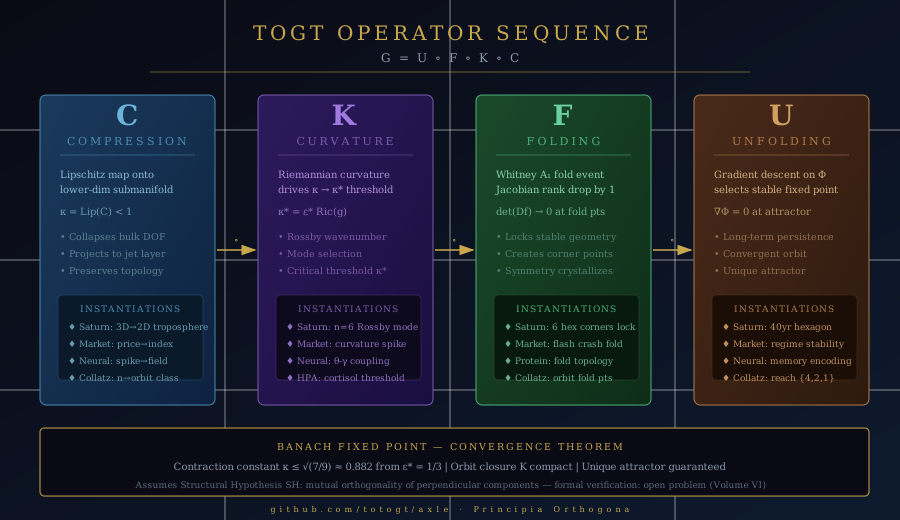
- The G-cycle is an ____________ chain that applies a series of transformations to circle data.
- The research team used Lean 4 to ____________ the theorems and make them verifiable by computer.
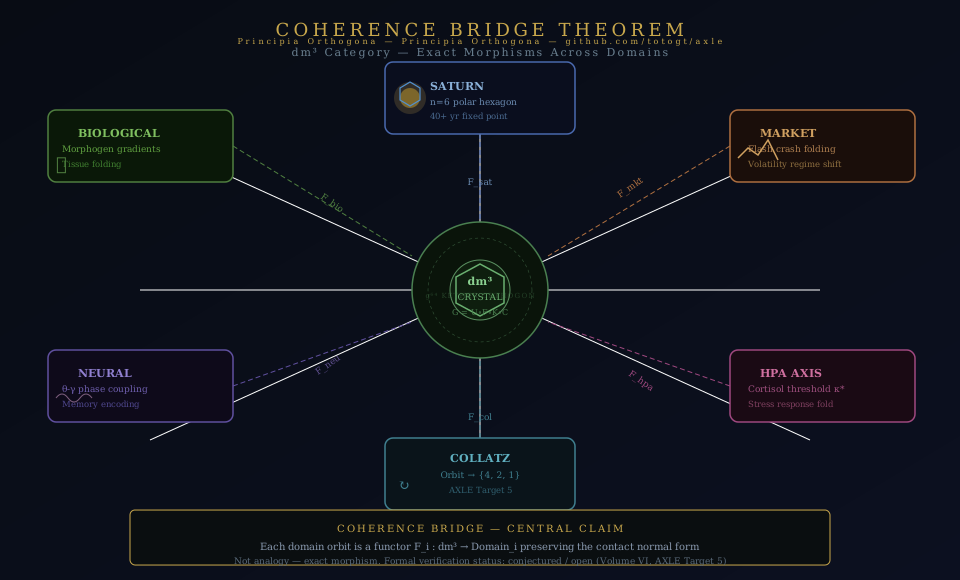
- The GCM ____________ provides a structured set of rules for modelling contact dynamics across many different systems.
Activity B: Grammar Focus — Passive Voice (10 min)
Rewrite these sentences in the passive:
1. Ahmes wrote the rule in the Rhind Papyrus around 1650 BCE.→ The rule ____________ in the Rhind Papyrus around 1650 BCE.
2. Da Vinci solved the ancient puzzle of squaring the circle visually.→ The ancient puzzle ____________ visually by Da Vinci.
3. The team has not yet proven Conjecture 5.4.→ Conjecture 5.4 ____________ yet.
4. Researchers formalized the theorems using the Lean 4 language.→ The theorems ____________ using the Lean 4 language.
5. Mathematicians classify π as a transcendental number.→ π ____________ as a transcendental number.
Activity: Discussion Cards — Groups of 3–4 · 7 min discussion + 2 min share
🃏 Card A — Discovery vs. Recovery
The G-cycle "packages the known ratio in operator language; it does not generate 8/9 from a blank circle." The framework finds the ancient answer — but only because it was already built in.
What is the difference between discovering something new and recovering something already known? Does that difference matter in science? In your own learning?
🃏 Card B — Honest Sorry
The author marks one conjecture as "honestly sorry" — he believes it is true but cannot yet prove it. He publishes the paper anyway.
Why might it be important to admit what you don't know? How does this connect to: "Neither of them read from a recipe book. Both of them ate the cake."
🃏 Card C — Ancient Wisdom, Modern Math
The Rhind Papyrus is nearly 3,700 years old, yet a paper published in 2026 in Newark, NJ still refers to it.
What does this tell us about knowledge? Can old knowledge be more valuable than new knowledge? What examples from your own culture can you think of?
🃏 Card D — Newark to the World
This paper was written by your teacher, affiliated with Hour House ESL, Newark, NJ — and published in an international mathematical series.
What does it mean that serious academic research comes from your community? Does knowing the author change how you read the paper?
Activity: Exit Paragraph — Written Response (choose one)
Option A — Summary: Summarise the paper in your own words. What problem does it address? What does it find? What does it admit it cannot yet prove? Use at least 6 vocabulary words from today's lesson.
Option B — Personal Response: What idea from today's lesson surprised you, moved you, or made you think differently? Connect it to your own life, background, or learning experience.
Option C — The Dedication: The paper opens: "Neither of them read from a recipe book. Both of them ate the cake. This is what education is, and what it is not." What do you think this means? Do you agree?
Activity: "Your Own Approximation" — Pair Reflection + Share
Discuss in pairs, then write 3–5 sentences for each:
- Think of something important you learned by doing rather than by following instructions. What was it? How did it feel to figure it out yourself?
- π cannot be written exactly. We use approximations (22/7, 355/113) because they are good enough. Can you think of other areas of life where a "good enough" answer is more useful than a perfect one that doesn't exist?
- This paper connects ancient Egypt, Renaissance Italy, and modern Newark. Where do you come from, and what knowledge did you bring with you?
"Every approximation gets us closer to the truth. So does every lesson."
⏱ Timing Summary
| # | Activity | Time |
|---|
| 1 | Warm-Up: Video + Discussion | 20 min |
| 2 | Introduction: Vocabulary + Context | 10 min |
| 3 | Presentation: Guided Reading | 20 min |
| 4 | Guided Practice: Vocabulary + Grammar | 20 min |
| 5 | Communicative Practice: Discussion Cards | 20 min |
| 6 | Evaluation: Exit Paragraph | 15 min |
| 7 | Application: Your Own Approximation | 15 min |
| TOTAL | 120 min |
Teacher Notes — For stronger B2/C1 students: assign Sections 3–5 of the paper as optional extended reading, or ask them to identify additional examples of passive voice in the original text. For lower B2 students: allow the reading in pairs, simplify the vocabulary worksheet, and provide sentence starters for the discussion cards ("I think this matters because… / In my experience… / This reminds me of…"). The video can be paused and rewound as needed. Mix levels for Stage 5; use same-level pairs for Stage 4.
© 2026 Pablo Nogueira Grossi / Hour House · 229 Ballantine Pkwy, Newark, NJ 07104 ·
Paper DOI:
doi.org/10.5281/zenodo.19984522 · CC BY-NC-ND 4.0 ·
Lesson designed using the CAELA Framework for Effective Lesson Planning for Adult English Language Learners