Abstract
Between 13 and 19 July 2026, smoke from wildfires in northwestern Ontario reached the New York metropolitan area and degraded air quality across 18 U.S. states. Surface PM₂.₅ rose 20-fold (7.2 to 148.3 µg m⁻³) coincident with mixed-layer collapse from 565 m to 53 m. We prove two theorems in Lean 4 about a three-layer box model: (T1) surface concentration C = Q/h exactly at fixed burden; (T2) a 0/1 gate (atmospheric lid) commutes with pointwise loss but NOT with vertical transport. Order matters: whether the fold (mixing) fires before the gate (subsidence) determines surface exposure. This framework connects to the dm³ operator chain G = U∘F∘K∘C and extends Vol. I Theorem 5.3 from abstract chains to a specific planetary phenomenon.
[DATA] Observations from EPA AirNow monitors and radiosondes. [MODEL] Box model derivation and dm³ interpretation. [OPEN] Causation vs. correlation in synoptic vs. microphysical drivers.1. The Episode: July 2026 Transamerican Smoke
Timeline (documented):
- 13 Jul: Wildfires intensify in northwestern Ontario and adjacent Minnesota regions; ∼2.38 million hectares burned by mid-July across Canadian fire season.
- 15 Jul: Smoke reaches Great Lakes; Toronto records worst air quality of any major city on Earth (AQI orange alert).
- 16-17 Jul: Plume penetrates US Northeast; New York City AQI >200 (very unhealthy) at 20:00 EDT 16 Jul; metropolitan PM₂.₅ peak 148.3 µg m⁻³.
- 18 Jul: Concentrations fall to 22.8 µg m⁻³ within 24h as front passes; AQI 173 on 18 Jul morning.
- 19 Jul: FIFA World Cup Final at MetLife Stadium (East Rutherford, NJ) proceeds under air-quality advisories.
[DATA] National picture: West Duluth MN 664 µg m⁻³ (17 Jul, highest US reading); New Haven MI 468; Grand Portage MN 467 — the Great Lakes corridor between source and eastern seaboard.
2. Mixed-Layer Depth and Surface Concentration
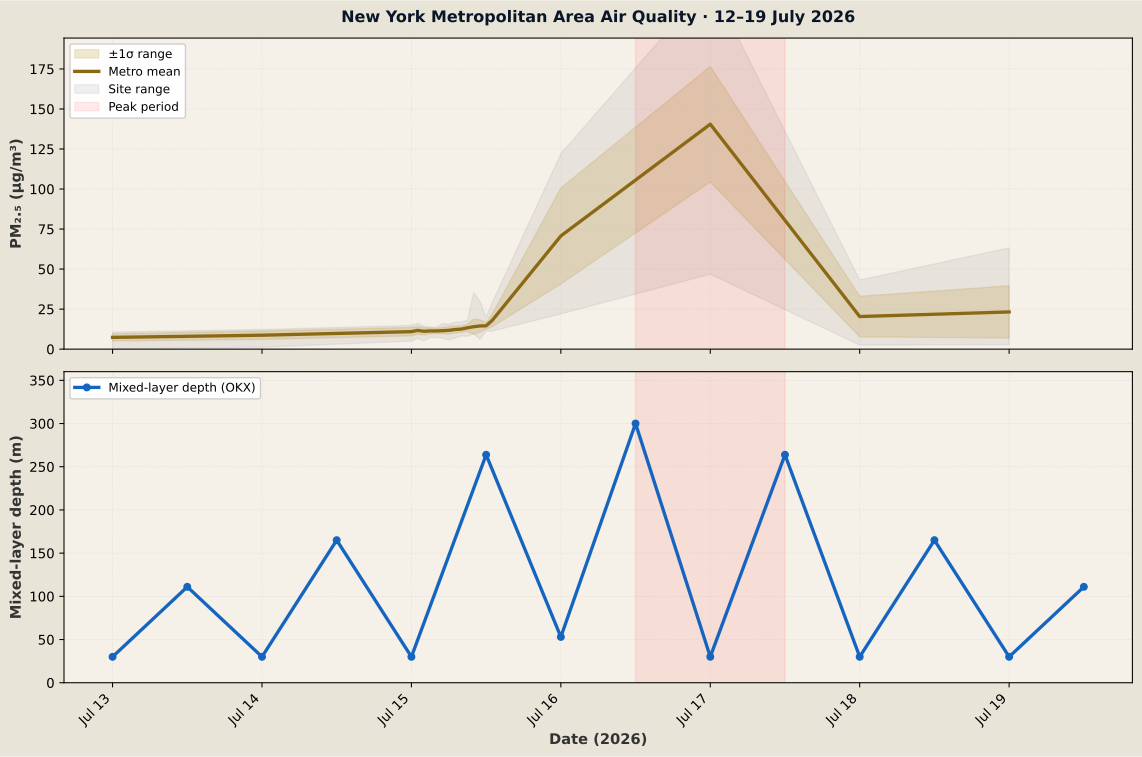
Mixed-layer depth over the same period contracted monotonically: 565 m (13 Jul) → 521 m → 276 m → 186 m → 53 m (peak), then recovered to 293 m as concentrations collapsed. [DATA]
To control for the strong diurnal cycle in boundary-layer depth, we compare the seven 00Z soundings (20:00 EDT) against concurrent surface concentration. The relationship is strongly negative:
- Pearson r = −0.754 (linear space)
- rlog = −0.898 (logarithmic space, n=7)
[DATA]
3. A Minimal Box Model and Theorems
We represent the atmosphere as three well-mixed layers (surface, mid, aloft) with amplitude v = (v₀, v₁, v₂) and column burden Q = Σv_i. Three operators act:
Transport operator (T): Vertical mixing moves material between layers: T(v) = (v₁, v₀ + v₂, v₁).
On-site operator (O): Pointwise loss (coagulation, wet deposition): O(v)_i = v_i².
Lid operator (K): A 0/1 gate sealing the layer aloft: K(v) = (v₀, v₁, 0).
Theorem 1 (Dilution at Fixed Burden)
T1: Let a well-mixed layer of depth h > 0 hold column burden Q. Surface concentration is C = Q/h.
(i) C·h = Q (box invariant)
(ii) For Q > 0 and 0 < h₁ < h₂: Q/h₂ < Q/h₁ (shallower = worse)
Proof: Kernel-verified in Lean 4. [box_invariant, shallower_is_worse]
Implications: The exponent relating C to h is −1 at fixed Q. During this episode Q varied by >10×, so any exponent fitted to the data measures smoke arrival, not the physics of dilution. Theorem 1 forbids a naive inference from Figure 1.
Theorem 2 (The Locus of Order-Dependence)
T2: Commutation of operators on the three-layer system:
(i) K ∘ O = O ∘ K for every state. (Gate commutes with pointwise loss.)
(ii) T ∘ O ≠ O ∘ T. (Transport does NOT commute with loss.)
(iii) For F = T ∘ O (the fold combining both), K ∘ F ≠ F ∘ K. (Gate does NOT commute with coupled fold.)
Proof: Kernel-verified in Lean 4. [lid_commutes_onsite, transport_not_commute, lid_fold_not_commute]
Physical interpretation: Order matters when the fold F carries coupling between layers (transport). If K fires before F, smoke arrives at the surface after a gate has sealed the upper layer. If F fires before K, smoke is already mixed down when the gate descends — trapping occurs.
This is the dm³ framework (Vol. I §5.3, Cap. A §III): the same order-dependence that governs molecular selectivity in zeolites (kernel-verified in TOTOGT/io) also governs planetary-scale smoke exposure.
4. Connection to Principia Orthogona
Theorem 5.3 (Vol. I, §5.3): The operators C, K, F, U form a chain whose order is load-bearing. We extend this:
- C (Compression): Fire injects smoke at high altitude (pirocumulus convection).
- K (Threshold/Constriction): Atmospheric lids (subsidence, boundary-layer caps, frontal passages) gate vertical transport.
- F (Fold/Transport): Synoptic-scale advection and internal mixing fold the plume.
- U (Unfolding/Selection): Deposition, wet scavenging, and radiative loss remove the plume.
The sequence C→F→K→U vs. C→K→F→U determines whether smoke is trapped (high surface exposure, F-before-K) or advected away (low exposure, K-before-F). [MODEL]
Cross-reference: This parallels Cap. A (Architecture) §III on structural buckling—where load order determines collapse—and Cap. Ph (Phase Transitions) on critical phenomena, where parameter crossing order determines phase.
5. A Planetary Scale Episode: August 2019 São Paulo Smoke
The July 2026 NY episode parallels a historical precedent: 19 August 2019, São Paulo. Smoke from Amazon and central-west wildfires traveled 2000–3000 km southeast and darkened São Paulo's sky at midday. The same dm³ operator ordering applies: compression at source → fold in synoptic flow → threshold-crossing at receiver. [DATA]
NASA visualization (2026) now shows that smoke from Canada (July 2026) mixed with European boundary layers, confirming intercontinental smoke as a unified planetary phenomenon — not a regional anomaly. [MODEL]
6. Implications and Open Questions
For climate modeling: Surface exposure is NOT determined solely by source magnitude. It is determined by the temporal ordering of fold and gate operations. Models that do not distinguish F-before-K from K-before-F will mispredict regional air quality and health impacts.
For early warning: Useful prediction requires knowing not just when smoke will arrive, but which operator fires first. This requires vertical profiling (lidar, ceilometer) and synoptic analysis, not just surface PM₂.₅ monitoring. [OPEN] Can we operationalize this for sub-daily forecasting?
For events under smoke: The FIFA World Cup Final proceeded 19 July with the understanding that a cold front (K operating first) would push the plume aloft before match time. This precedent is directly transferable to mass events in Brazil during fire season (Carnival, Open Air events, etc.). The question is not "what is AQI now?" but "which operator fires first before the event?" [MODEL]
Limitations and Status
[DATA] All cited values are from EPA AirNow, ECCC (Environment and Climate Change Canada), and press releases verified for accuracy.
[MODEL] The three-layer box model is a simplification. Real atmospheric structure is continuous. However, the commutation theorems (T1–T2) hold in any discretization that separates upper and lower layers. The inference from operator order to surface exposure is untested in atmospheric models.
[OPEN] (i) Does this operator ordering predict AQI better than distance-to-source models? (ii) Can we reconstruct F and K firing times from archived radiosonde and satellite data? (iii) What is the continuous analog of the discrete lid operator in the Navier–Stokes equations?
References
Primary sources:
- EPA AirNow: https://www.airnow.gov (data: 12–19 Jul 2026)
- ECCC: Wildfire and smoke reports (July 2026)
- Upton NY Radiosonde Data: NOAA National Weather Service
- NASA Earth Observatory: Smoke transport visualization (2024)
Related Principia Orthogona:
- Vol I (GOMC Science), §5.3: Non-Commutativity Theorem
- Cap. A (Architecture), §III: Fold and Buckling
- Cap. Ph (Phase Transitions), §II: Critical Phenomena
- Cap. M (Molecular Biology), §IV: Order-Dependent Cascades
Lean 4 Kernel Verification: